
You know that moment when your kid suddenly recognizes a letter during prayer and gets all excited? "Mama, that's the ba from my game!" Yeah, that moment. That's what we're going for here.
Teaching Arabic doesn't have to be this huge or stressful. I know you've probably tried the flashcard routine or sat down with a workbook, and maybe it went... okay? Or maybe your child ran away after five minutes. Either way, you're here because you want Arabic activities for kids that actually work.
How about a kid-friendly Arabic alphabet learning method that doesn't require any force but rather happens naturally through play and fun? I think we can make this much simpler for both of you.
Why Are Arabic Activities So Important for Kids?
Honestly? Arabic activities for kids do way more than teach letters. They're building something bigger.
Connection to the Qur'an
Arabic isn't just another language on the roster. It's the key to understanding what your child says in prayer every single day. When they start recognizing words in Surah Al-Fatiha or spot "Allah" written somewhere, something clicks. These letters aren't random anymore—they're connected to something they already love. That's when Qur'anic Arabic for kids stops being a subject and becomes personal.
Cognitive Development
Kids learning Arabic is a brain boost for them. The bilingual children have more vibrant memories and improved problem-solving skills and they become very proficient in recognizing patterns. When children learn by playing and engaging in an activity, they are essentially creating neural pathways that will support all their other learning.
Cultural Identity and Heritage
It is quite impressive for a kid to realize that the language he speaks is shared by more than 400 million people all over the world. The Arabic language links your child with an enormous, lovely community and a long history that dates back many centuries. When they can read even some Arabic, they become more confident. They are part of something bigger than themselves, and they experience that.
Language Confidence
You know what kills language learning? Fear of messing up. But Arabic activity for kids that feels like play? That changes everything. When your child is building letters out of playdough or playing hopscotch with the alphabet, mistakes don't feel scary. They feel like part of the game. And that confidence? It carries over into actually speaking, reading, and trying new words without freezing up.
One mom told me, "My 5-year-old now points at Arabic signs at the masjid and tries to sound them out. Activities turned fear into curiosity."
Discover more about why learning Arabic matters for Muslim kids.
So why do activities work so much better than the old-school drill-and-repeat method? Let's get into that next.
Benefits of Learning Arabic Through Activities Instead of Memorization
You bought the workbook. You sat down with good intentions. Your kid lasted maybe three minutes before suddenly needing water, the bathroom, and to tell you about something that happened six months ago. Sound familiar?
It's not you. It's not your kid. It's just that most children aren't built for drill-and-repeat. Here's what actually happens when you compare the two:
| Traditional Memorization | Activity-Based Learning |
| Feels like work | Feels like play |
| Short-term retention | Long-term memory |
| Can cause resistance | Builds natural curiosity |
| One-size-fits-all | Adapts to learning styles |
The difference is pretty clear, right? Activities work with your child's instincts instead of fighting against them.
Kids Stay Engaged
Your kid might bolt from a worksheet, but hide the letter "ت" (ta) around the living room? Suddenly, they're a detective on a mission. Same letter, completely different vibe. The point is to make activities feel less like work and more like a game. And it's a proven fact that when children are enjoying themselves, they take in new information effortlessly.
Learning Becomes Natural
Remember how your child picked up English? You didn't drill alphabet cards when they were two. They heard you talking, sang songs in the car, and listened to stories at bedtime. That's how language actually sticks. Arabic works the same way. A song here, a game there, a craft on a rainy afternoon—these tiny moments build up naturally. No force, no stress. Just bits of Arabic woven into regular life.
Builds Long-Term Memory
When your child traces "م" (meem) in a tray of rice, then molds it with playdough, then spots it in a book—boom. That letter is locked in from every angle. Multi-sensory learning isn't just fancy education jargon. It literally means their brain is creating connections through sight, touch, sound, and movement. The more ways they experience a letter, the harder it is to forget.
Encourages Creativity and Confidence
There's something magical about a kid making their own Arabic letter poster or building the alphabet out of blocks. It's theirs. They created it. And that ownership? It builds this quiet confidence that spills into everything else.
Plus, when learning involves creating and expressing themselves, kids actually care about what they're doing. Moreover, children do love what they are doing when the learning involves making and self-expression.
Seriously, if you attempted the memorization method and it didn't work, it doesn't mean you were unsuccessful. It only implies that you haven't discovered the right method yet. Every single play-based interaction is valuable, regardless of your child's age, whether four or twelve. You are not behind—you are at the right place.
Actually, before we get into the activities, let us discuss one simple tool that makes everything so much easier: a really good alphabet chart. Believe me on this one.
Try our Arabic tracing and matching games. Kids learn letters effortlessly while having fun! Start playing.
Arabic Alphabet Chart (Alif to Yaa)—A Visual Learning Essential
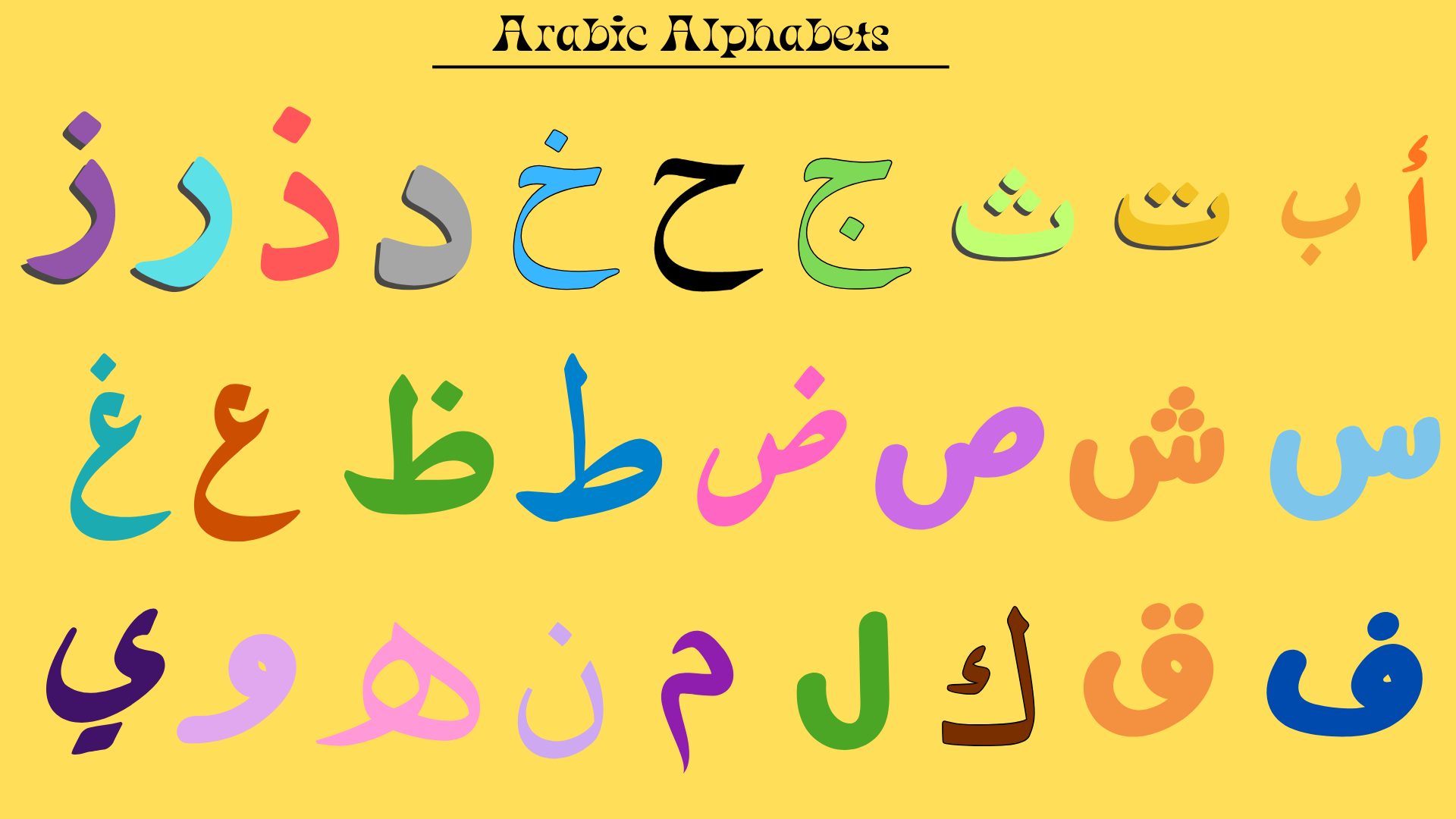
Before you jump into games and crafts, get yourself an Arabic alphabet chart. Seriously, this one simple tool does more heavy lifting than you'd think.
Why Charts Matter
Visual learners make up the majority of children. For them to remember, they need to see things. Put up an Arabic alphabet chart for children in a place where your kid is having breakfast or is brushing his teeth, and within a very short time, those 30 seconds of daily exposure will have a great effect. That is learning passively at its finest. Plus, charts make great warm-ups before activities. "Can you find the letter that starts asad (lion)?" Boom, you're ready to go.
What Makes a Good Arabic Alphabet Chart
Try to find one that has bright, big letters, not only shown individually but also in words. The color of the poster should be attractive enough to entice the viewer but not so much as to overwhelm or distract him at all. Vowel marks (harakat) are necessary for correct pronunciation. Pictures help too—kids connect better when they see "ba is for baqara (cow)." And get it laminated or printed on sturdy paper because tiny fingers will be pointing at it constantly.
How to Use It
Start simple: "Can you find alif?" Then move to sounds: "What does 'ba' say?" Connect it to words: "Ba is for baqara—can you moo like a cow?" Before long, you're playing point-and-name races or I Spy games with the chart. It grows with them.
Now let's get to the fun part—actual activities your kids will actually want to do.
10 Fun and Effective Arabic Activities for Kids
These are ten activities that genuinely produce results—simply a desire to experiment with something new, not a PhD, is needed.
1. Arabic Alphabet Flashcards
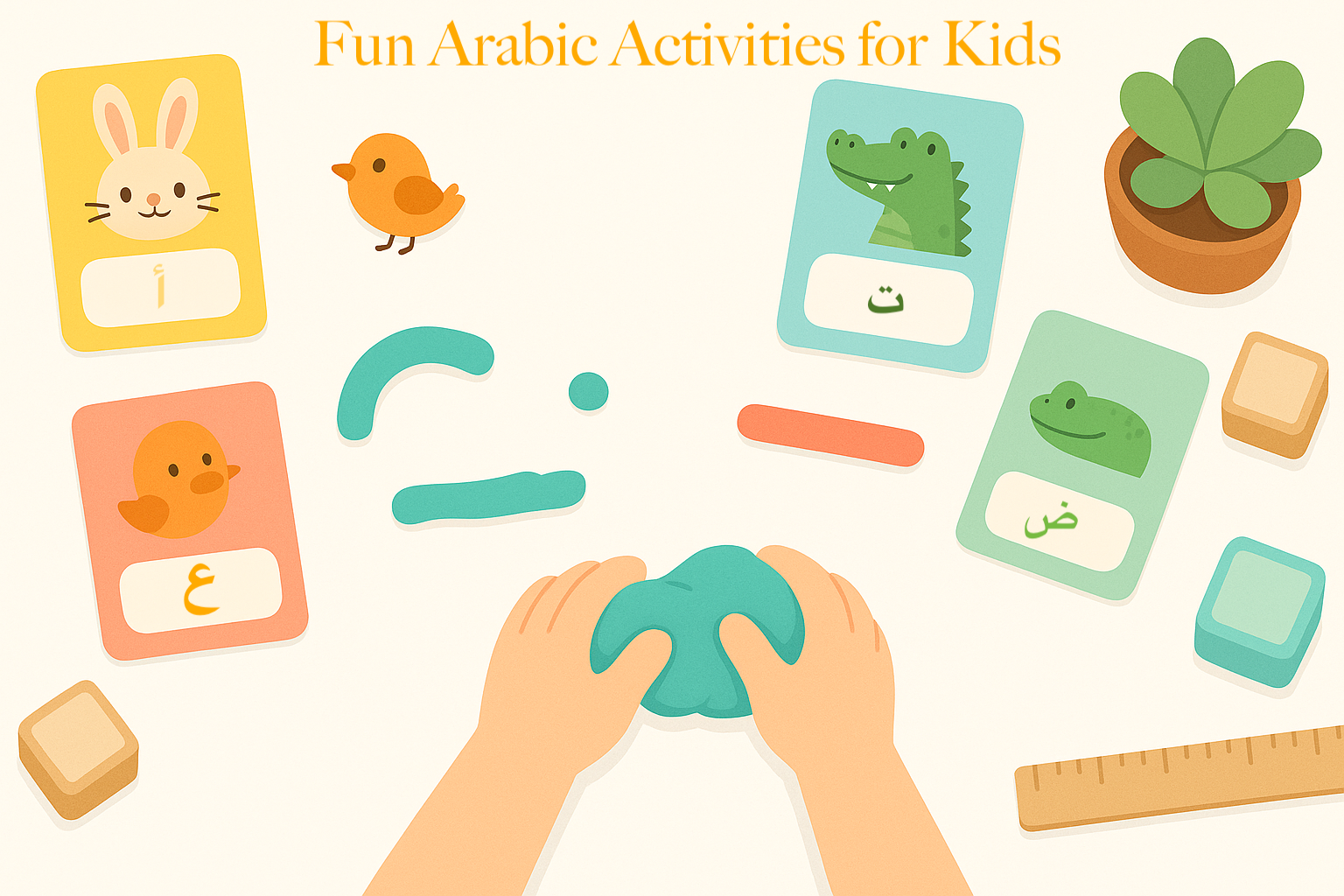
The classic that never gets old. Flashcards build letter recognition fast, and you can use them a million different ways.
Best for: Ages 4–10
What you need: Printable flashcards (or make your own with images on one side and letters on the other)
How to use: Start with just 3–5 letters. Play matching games or memory flips, or do quick reviews before school. One card while you're waiting at the doctor's office? That counts.
Learning outcome: Quick letter recognition, stronger visual memory
Parent tip: Keep a stack in the car. Traffic jams and waiting rooms just became learning time.
2. Coloring & Tracing Sheets
Fine motor skills meet Arabic—it's a two-for-one deal. Kids trace letters and develop the muscle memory they'll need for writing.
Best for: Ages 4–8
What you need: Printable tracing worksheets, crayons or markers
How to use: Start with big dotted letters that they can trace, then let them color them in. Progress to smaller letters as they get confident. Try rainbow tracing—the same letter in multiple colors—for extra fun.
Learning outcome: Letter formation, writing muscle memory
3. Arabic Alphabet Playdough Shapes
Sensory play that sticks in their memory. Perfect for kids who learn best by touching and doing.
Best for: Ages 3–7
What you need: Playdough (homemade or store-bought), letter cards for reference
How to use: Show a letter like "ب" (ba), then have them roll and shape playdough to match it. Say the sound together while building. Eventually work up to whole words.
Learning outcome: 3D letter understanding, fine motor skills, tactile memory
Parent tip: Knead in a drop of lavender essential oil for calming focus time. Multi-sensory magic.
4. Matching Games (Letter to Picture)
Connect letters to real words through visual association. This is where vocabulary starts building naturally.
Best for: Ages 4–9
What you need: Cards with Arabic letters, cards with matching pictures/words (like "أ" with "rabbit")
How to use: Lay the cards face down and turn two cards face up to find a pair.
When you have matched them, say the letter and the word aloud. Keep the pairs as wins.
Learning outcome: Letter-sound-word connection, vocabulary growth
Digital option: Try our interactive Arabic matching games online—pronunciation included automatically!
5. Arabic Alphabet Hopscotch
Burn energy while learning. Movement plus letters equals memories that stick.
Best for: Ages 5–10
What you need: Use chalk for outside or tape for inside, draw a hopscotch grid with Arabic letters in the squares. inside, and
How to use: Call out a letter; your child hops to it and says the name and sound when they land. Advanced version: call out a word, and they hop to its first letter.
Learning outcome: Gross motor skills, letter recognition, energy release
Parent tip: This is perfect for high-energy kids who can't sit still. Learning through movement actually works better for some children.
6. Arabic Storytime
Immersive listening that builds comprehension and love for the language.
Best for: All ages (just adjust the story complexity)
What you need: Arabic children's books with pictures, Islamic stories with Arabic words, and books with transliteration
How to use: Read slowly and point to words. Let your child repeat key Arabic words. Talk about the pictures and ask simple questions in Arabic, like "What color is that?"
Learning outcome: Listening skills, vocabulary in context, and genuine love for Arabic
Islamic connection: Choose stories about the Prophets or Companions. Arabic becomes the key to connecting with their faith heroes.
7. Alphabet Songs & Nasheeds
Music makes memorization effortless. Kids absorb the alphabet order naturally through rhythm and repetition.
Best for: Ages 3–8
What you need: YouTube, Spotify, or CDs with Arabic alphabet songs, optional lyrics sheet
How to use: Play during car rides, cleanup time, or transitions between activities. Sing along together. Add hand motions for each letter. Make it a family tradition.
Learning outcome: Alphabet sequence memorization, pronunciation, joyful association with Arabic
Parent tip: Repetition is everything. Play the same song daily for a week before switching. Consistency beats variety here.
8. Arabic Alphabet Puzzle Games
Problem-solving meets letter learning. Puzzles challenge their brains while teaching letter shapes.
Best for: Ages 4–10
What you need: DIY option—print letter images and cut into puzzle pieces. Or buy wooden Arabic alphabet puzzles.
How to use: Start with simple 3-piece puzzles for little ones. Work up to full alphabet puzzles. Older kids love time challenges: "Can you beat your record?"
Learning outcome: Spatial reasoning, letter shape recognition, persistence
9. Magnetic Letter Boards
Hands-on, reusable, and zero prep required. This is the lazy parent's dream tool (and I mean that as a compliment).
Best for: Ages 4–12
What you need: a Magnetic whiteboard or just your fridge, Arabic magnetic letters
How to use: Leave 1–2 letters on the fridge for your child to discover each morning. Build simple words together like بيت (house). Create patterns or practice spelling.
Learning outcome: Letter manipulation, word building, independent exploration
10. Interactive Online Games
Screen time with an actual purpose. Good digital tools allow instant feedback and are really engaging for the children.
Best for: Ages 4–12 (choose age-appropriate content)
What you need: Tablet or computer, trusted educational platforms
What to look for: Tracing games with stroke guidance, matching and memory games, pronunciation audio, progress tracking, and Islamic-friendly content (no inappropriate music or visuals)
Learning outcome: Tech literacy plus Arabic skills, self-paced learning
Want instant access to all these activities and more? Join IslamicGalaxy for Arabic games, printables, and video lessons!
Online Arabic Activities for Kids (Fun + Screen-Time Friendly)
Not all time spent in front of a screen is equally productive. If done purposefully, Internet-based Arabic exercises may indeed be effective learning instruments—particularly in a situation where you are trying to manage your job, prepare dinner, and deal with a child's tantrum because of a wrongly colored cup.
I know the guilt. Often, when you give your child a tablet, you may think that you are failing as a parent. However, the truth that I want to get through to you is this: educational use of digital media is far from being comparable with just watching YouTube videos for three hours without any involvement. When your child is actively tracing Arabic letters or matching words to pictures, their brain is working. That's real learning, not just babysitting via screen.
Best Types of Online Arabic Activities
1. Alphabet Tracing Videos
These show exactly how to form each letter, stroke by stroke. Children see the cartoon, trace with their finger on the screen, and then do it on paper. It is a combination of visual and hands-on, which is happening simultaneously. This is very helpful, especially for those that are complicated and have different forms depending on the word. Way easier than you trying to explain it for the fifth time.
2. Arabic Matching Games
Digital memory games where they match letters to sounds, pictures, or words. The instant feedback is what makes these work—kids know immediately if they got it right. No waiting, no wondering. And because they can replay levels as many times as they want, there's zero pressure. Just practice until it clicks.
3. Animated Letter Lessons
Short videos—like 3 to 5 minutes max—that introduce one letter at a time. Good ones include pronunciation, example words, and visuals that actually keep kids interested. The really good ones connect letters to meaningful Arabic words from the Qur'an or daily duas. So your child learns "ر" (ra) and also discovers it's in "رحمة" (mercy). Now that the letter means something beyond just a shape.
4. Interactive Vocabulary Games
Children move letters to form words or press a picture to hear the Arabic names of things. The whole points-and-badges thing keeps them hooked without it feeling like school. They're learning vocabulary while thinking they're just gaming.
5. Voice Recognition for Pronunciation
Some apps now let kids speak Arabic words and get instant feedback on whether they said them right. This is a game-changer for speaking confidence. It's also perfect for parents who aren't fluent themselves—the app becomes the pronunciation coach you can't be. Your child can practice saying "السلام عليكم" correctly without either of you feeling awkward about it.
How Online Activities Support Busy Parents
Let's talk about why digital tools are actually your friend here.
Zero prep work. No printing, no scissors, no "Where did I put those flashcards?" Just open the app and go. Your kid gets the same great lesson even if you are super managing or barely holding it together. Most systems also keep a record of the progress, so you can know exactly which letters they have mastered and which ones are still difficult for them—there is no guessing.
Older kids can work through stuff independently. Ages 7 and up? They can often handle lessons solo, which means you can make dinner or answer that work email without the guilt spiral. And honestly, a well-made animated video will hold your 5-year-old's attention way longer than a worksheet. It just will.
The screen time guilt? Let it go. Fifteen focused minutes of interactive Arabic games beats an hour of mindless scrolling every single time. Choose platforms with Islamic-friendly content, actual learning objectives, and parent controls. Then trust that you're making a good call here.
Now let's talk about bringing Arabic into your actual home—beyond the screen—because the magic really happens when digital and real-world learning team up.
Give your child screen time that builds skills. Join IslamicGalaxy for unlimited access to high-quality, Islamic-focused Arabic learning activities—videos, games, and interactive lessons designed by educators who get Muslim families. Try it free
Easy Arabic Activities for Kids at Home
Here's the truth: you don't need any special stuff to teach Arabic at home. No fancy curriculum, no teaching certificate, nothing. You've probably got everything you need already sitting around your house. Your kitchen table? That's a classroom. Your fridge? Learning tool. Let's get creative with what you've already got.
1. Whiteboard Writing Practice
Get a cheap whiteboard and stick it somewhere your kid walks past every day—the bathroom, their bedroom door, wherever. Every morning, write one letter on it. Leave a marker next to it. Done. That's the whole activity. So, they might be brushing their teeth and decide to draw a line on the board or do it completely off track and not think of the day. And since it's a whiteboard, if they mess up, it is not a big deal—just erase and do it again. Zero pressure.
2. Refrigerator Magnet Games
Toss some magnetic Arabic letters on your fridge and just... Leave them there. While you're making eggs, spell a word together. Put all the ب letters in a row. Spell out "صباح الخير" before they wake up. The magic here? Your kid opens that fridge ten times a day for snacks. Each time, those letters are right there in their face. They're learning without even knowing it. That's the dream right there.
3. Sticker Charts for Motivation
Draw up a chart with all 28 letters on it. Every time your kid learns one, they get to stick a sticker on it. Make a big deal every 5 stickers—ice cream, park trip, whatever gets them hyped. Kids love watching those stickers add up. It's visual proof they're getting somewhere, and that feeling keeps them going way more than you nagging them to practice.
4. Letter Scavenger Hunts
Hide letter cards around your house and make them find them. Give clues like "Find the letter that starts qalb (heart)—look somewhere you love!" They tear around the house, find the letters, and line them up. If they're older, hide word cards they have to arrange into sentences. The running around + solving puzzles + learning combos? That's a chef's kiss, especially if your kid has energy to burn.
5. Arabic Labels Around the House
Grab some sticky notes or tape and label everything. "باب" on the door, "كرسي" on the chair, "كتاب" on the bookshelf. Add little pictures if they're just starting out. Change them up every few weeks so it stays interesting. Think about it—your kid learned "door" because they heard you say it while pointing at doors a thousand times. Same deal here. Constant, natural exposure does most of the work for you.
6. Bedtime Routine in Arabic
Incorporate a little bit of Arabic language in bedtime routine, read one Arabic picture book, recite your bedtime duas together, look through a few flashcards, or sing an Arabic lullaby. There's actually science behind this: calm bedtime routines help stuff stick in their memory overnight. Plus, when Arabic = cozy bedtime instead of stressful homework time, they actually want to do it. That association matters.
Don't try to do everything at once. Pick one. Just one. Maybe the fridge thing is because you literally just stick letters up there and you're done. Or the whiteboard because you've got one collecting dust somewhere. Test it for a week and find out what will happen. There could be days when you only get five minutes, and there could also be days when you get nothing, and that's perfectly fine.
Arabic Alphabet Activities for Kids by Age
Here's the thing: a 4-year-old will get bored with what a 10-year-old is doing by a mile, and a 10-year-old will be completely overwhelmed if the challenge is for a preschooler. Children learn differently at different ages, and to try to impose the wrong activity on the wrong age group is just to frustrate all the people involved.
Ages 4–6 (Play-Based Learning)
Little kids at this age? They're all about big movements, short bursts of attention, and touching everything. We're not trying to get them writing yet—we just want them to recognize letters and connect sounds.
What actually works:
Sensory stuff is your best friend here. Let them trace letters in a tray of rice or sand. Give them playdough and let them roll out the shapes. Hand them a paintbrush and a cup of water, and let them "paint" Arabic letters on the sidewalk. It'll dry and disappear, and they'll want to do it again. That's the point.
Get them moving. Do alphabet hopscotch in the driveway. Play freeze dance where you call out a letter, and they have to freeze on it. Try "Simon Says" with basic Arabic words. Their whole body is part of how they learn right now—use that.
Keep it playful and quick. Play alphabet songs in the car until everyone's sick of them (repetition is good). Read picture books with maybe one or two Arabic words per page. Let them play with magnetic letters on the fridge. Simple matching games where they match a letter to a picture. That's plenty.
Ages 7–9 (Structured + Creative Activities)
Now we're talking. They can sit for 15-20 minutes, they're starting to write actual letters, and they want to form real words and feel like they're accomplishing something.
What actually works:
Writing practice that doesn't suck. Tracing worksheets with dotted lines, they can follow. Having them copy simple words—their name, "mama," "baba," and family stuff they care about. A little "Arabic journal" where they write one word or sentence each day. Rainbow writing, where they trace the same letter in five different colors, because somehow that makes it fun.
Let them make stuff. Their own flashcards, an Arabic alphabet book, and posters with their word of the day. If they create it themselves, they'll remember it way better than if you just hand them something.
Start reading for real. Sound out short words together. Match words to pictures. Read super basic sentences like "هذا كتاب" (This is a book). Start pointing out words they know in the short surahs they're learning for prayer.
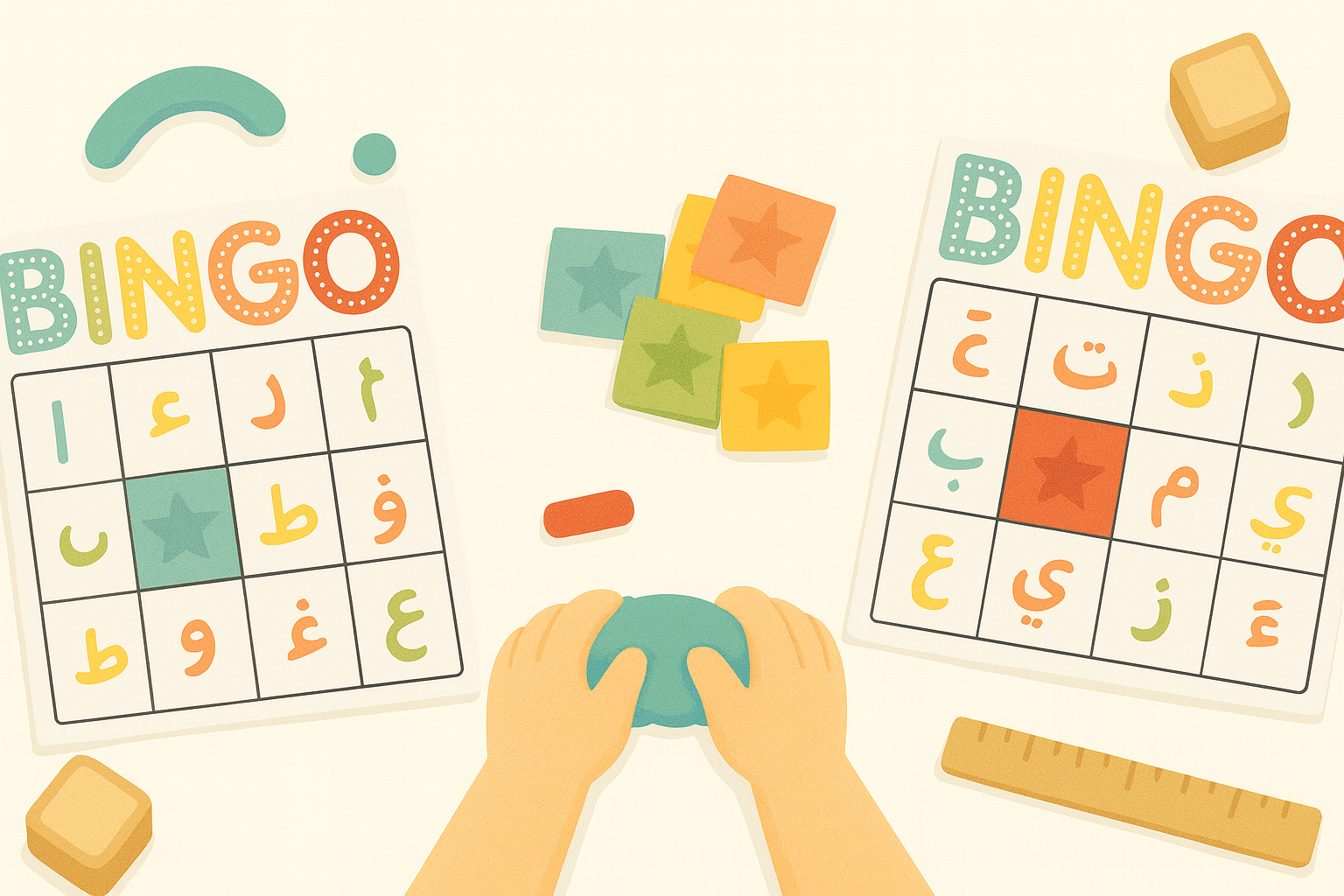
Games that challenge them a bit more. Matching word families, Arabic bingo, building words with letter tiles, and those online tracing games they can do on a tablet.
The prayer connection: This age is perfect for recognizing the actual words they say in salah. Practice spotting "Alhamdulillah" and "Allahu Akbar" and words from the surahs they know. Suddenly, prayer and Arabic learning connect, and that clicks for them.
Ages 10–12 (Reading, Writing & Vocabulary)
Okay, at this point, they are really prepared to go down and explore the matter. Their concentration lasts for 20-30 minutes, they require genuine challenges, and the idea of being independent and doing things on their own is gradually becoming dear to their hearts.
What actually works:
Real reading. Get them actual Arabic storybooks for kids, short hadith with translations, start working on the Qur'an with proper tajweed, Arabic newspapers made for kids, and simplified Islamic history books. They can handle real content now instead of just baby stuff.
Writing with a purpose. Have them keep an Arabic journal (even just a few sentences). Write letters to grandparents in Arabic. Copy out their favorite Qur'an verses beautifully. Make vocabulary notebooks organized by topic. When writing has a point, they'll do it.
Build vocabulary that matters. Word-of-the-day challenges. Theme weeks (this week: food words, next week: animal words). Practice using new words in actual sentences. Try basic Arabic conversations. Label things in Arabic around the house.
Actual games that make them think. Arabic Scrabble, crossword puzzles, translation challenges (can you say this in Arabic?), and typing practice in Arabic online.
Connect to their faith. Read short surahs and actually understand what they mean. Learn what the phrases in salah translate to. Study the names of Allah. Read the Prophet's biography in simple Arabic. Make Arabic the key to understanding their deen deeper.
Use tech smartly. Typing practice in Arabic, language apps that work, watching Islamic videos with Arabic subtitles, and maybe even online pen pals with Muslim kids who speak Arabic.
Quick Cheat Sheet
| Age | What They're Learning | What Works | How Long |
| 4–6 | Just recognizing letters and sounds | Sensory play, songs, and moving around | 5-10 min max |
| 7–9 | Writing letters, making simple words | Tracing, crafts, word games | 15-20 min |
| 10–12 | Actually reading, building vocabulary | Books, journals, Qur'an study | 20-30 min |
Conclusion
Making Arabic Learning Joyful for Every Child. If you've made it this far, you're already doing something beautiful. You're investing in your child's connection to Arabic.
Teaching Arabic at home isn't always smooth. Some days, your child will trace letters with pure joy. Other days, they'll run the other way. Progress feels painfully slow, and then one random Tuesday, they're reading Bismillah on their own, and your heart just melts. That's learning—small, sacred steps that add up quietly.
Here's what actually matters: Arabic activities for kids work best when they feel like play, not pressure. Flashcards at breakfast, songs in the car, games before bed—every tiny moment plants seeds. Start with one activity this week. Build from there.
Mix it up based on your kid. Crafts for hands-on learners, videos for listeners, and movement games for your human tornado. Watch what lights them up, then do more of that.
And listen—you don't need to be perfect or fluent. You just need to show up consistently and celebrate their efforts. Your child isn't comparing you to anyone. They're watching you try alongside them, making Arabic something you discover together.
You've got dozens of activities now. Pick one for this week. Maybe print that alphabet chart, try a matching game, or watch a letter video together. Next week, add something else. Before you realize it, Arabic will be naturally woven into your home, and your child will shock you with what they've
If you want a partner in this—ready-to-use videos, games, worksheets, and a community of parents on the same path, IslamicGalaxy is here. We've built everything to make Arabic learning joyful, consistent, and rooted in Islamic values. Join IslamicGalaxy and watch their love for Arabic grow. Start your free trial now!
May Allah make this journey easy for you and your family, and may the letters your child learns today become keys that unlock understanding, wisdom, and closeness to Him. Ameen.
FAQs
Q1: What is the best way to learn the Arabic alphabet?
The best way is through multi-sensory activities that engage sight, sound, touch, and movement. Combining tracing practice, songs, games, and daily exposure helps children absorb letters naturally—far more effectively than rote memorization alone.
Q2: How long does it take for kids to learn Arabic letters?
Under the condition of regular daily practice (10–15 minutes), most kids can identify the 28 letters of the Arabic alphabet within a period of 3–6 months. Writing skills usually develop over a 6–12 month period and are influenced by the child's age and how often they practice.
Q3: Can young kids learn Arabic at home without a teacher?
Yes! With the use of good material and work on the part of the parents, kids can be taught Arabic at home, even if parents are not fluent in the language. The new generation of learning aids, such as videos, apps, and interactive games, is a source of correct pronunciatio,n and they have a structured approach that is a perfect way for a parent to lead the learning process.