
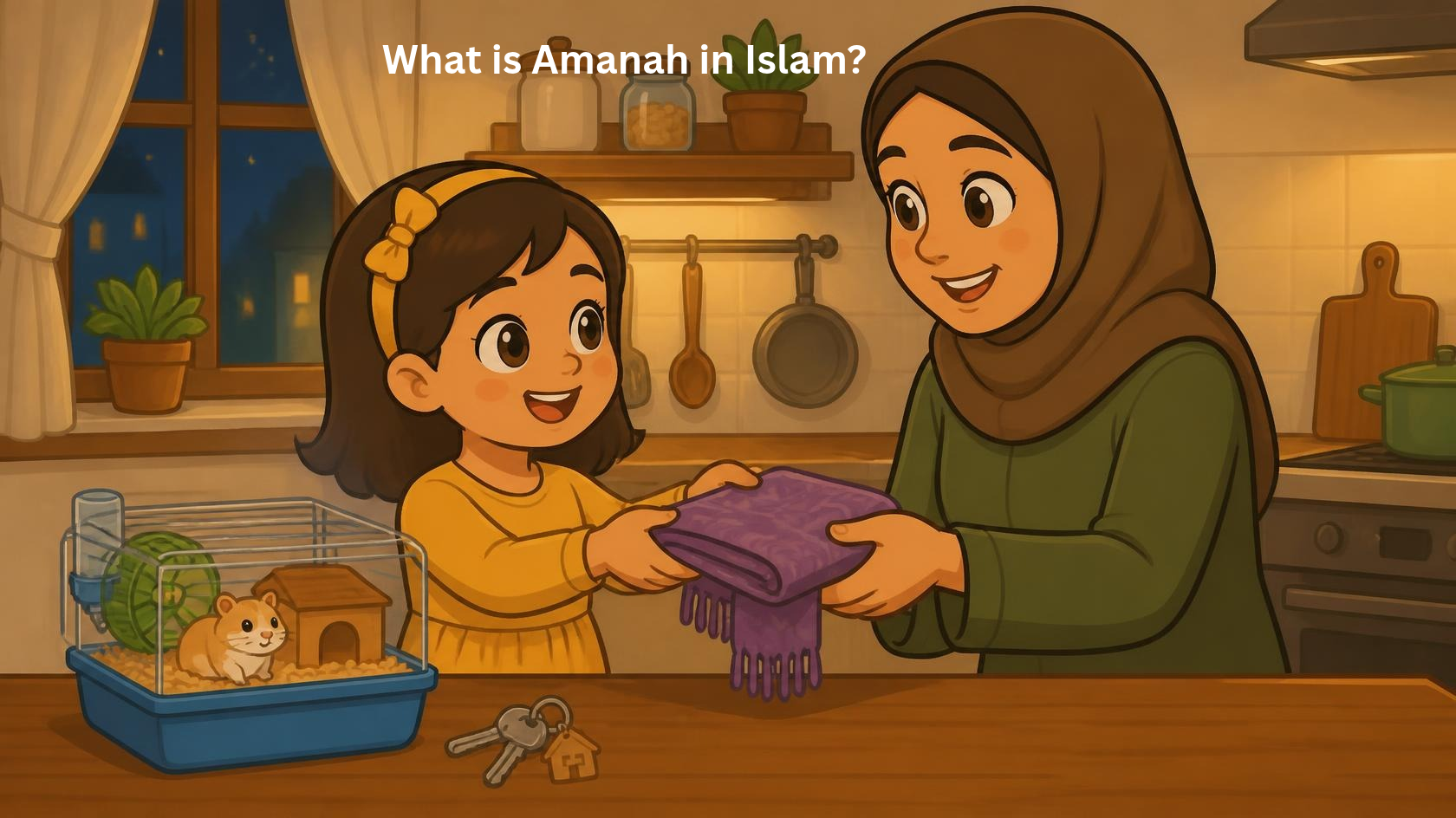
I lent my niece my good scarf once. She's seven. The silk one, the one I don't lend to anybody, and she wore it to a friend's house and lost it somewhere between the car and the front door. She came back with this look, shoulders up near her ears, waiting for me to explode.
And standing there, I realized the scarf didn't matter. What mattered was whether she'd tell me, and whether I'd ever trust her with something again.
That's amanah, more or less.
What amanah is
A trust. Something put in your hands to look after. A borrowed book, a friend's secret, your little brother while Mum nips to the shop for ten minutes. Scholars say even our bodies, our time and our abilities are trusts from Allah.
The Quran says it in Surah An-Nisa, give trusts back to the people they belong to. No loopholes in that one.
And before prophethood the people of Makkah called Muhammad, peace be upon him, Al-Amin, the Trustworthy. They left their valuables with him, and even the ones who later fought him still did. A kid understands that right away. He's the person you hand your stuff to without thinking about it.
Tiny everyday amanah
Forget the big stories for a minute. It lives in small things.
Minding a classmate's pencil case. Not opening your sister's diary even though it's lying right there. Feeding the class hamster over the weekend and actually doing it.
Holding the change when Dad says "keep this for me at the shop."
Ask your child who they trust most and why. The answer's almost always the same: she does what she says, he never tells. Trust is just boring reliability, repeated a lot.
Family privacy counts
Parents tend to skip this bit. Some stuff at home is ours. An argument, a money worry, Grandpa's health, whatever got said at dinner. It doesn't all need to travel to school on Monday.
There's a hadith that gatherings are held in trust, so what's said in confidence stays put. In my house the rule was "our business stays in this house", grumpy, old-fashioned, and every kid got it first time. It works the other way as well. When a friend tells your child something private, that's a trust too.
The exception every child must know
Read this part twice. Amanah never means keeping a secret that makes a child feel scared, uncomfortable, hurt or unsafe. If any adult, or any older kid, asks them to keep something quiet that feels wrong (a touch that felt off, a threat, something frightening online) the child tells you. Straight away. They will not be in trouble.
Say it plainly. Say it a lot, until it's boring. "There are private things and there are unsafe secrets, and unsafe secrets always get told to Mum or Dad." Trust and safety sit side by side in a good family, and when they clash, safety wins.
Our post on helping kids handle bullying says more about when to speak up.
Practicing it at home
Give small jobs with real trust attached. Carry the house key on the walk home. Mind a cousin for ten minutes. Then notice it, once, offhand: "I trusted you with that and you handled it." Beats any speech.
Own your slips too. Forgot a promise? Say sorry in front of them. Kids pick up amanah mostly by watching whether we keep ours.
For something hands-on, our activities for kids have ways to practice honesty and responsibility, which sticks better than a talk at the kitchen table.
Conclusion
My niece told me about the scarf that same evening. Quietly, in my kitchen, hands behind her back. I said thank you for telling me. The scarf turned up two days later under the car seat. What I actually remember is her shoulders dropping when she worked out that telling the truth was safe. That's the part worth teaching, I think. For more videos, games and activities that build good character together, explore everything at Islamic Galaxy.
FAQs
What does amanah mean for children? Amanah means being trusted with something and taking care of it, like a borrowed item, a friend's private words, or a younger sibling. It includes being honest, responsible, and someone others can rely on.
Should my child keep every family secret? Private family matters can stay at home, but a child should never keep a secret that feels scary, unsafe or wrong. Teach them that unsafe secrets must always be told to a trusted parent right away, every time.
How do I teach my child to be trustworthy? Give small responsibilities, praise them when they follow through, and keep your own promises. Children learn trust mostly by watching adults who are honest and reliable in everyday moments, so your example matters most.