
The day of Dhul Hijjah is getting close fast, thus the special excitement begins to emerge at home in connection with preparation for Qurbani, who will this year be the one hosting the celebration of our family, have our kids got their new clothes? While it is possible to say that not everything about Eid al-Adha is fun compared to Eid al-Fitr. Nevertheless, there are great differences between these festivals. It is necessary to note that Eid al-Adha cannot be done quickly.
The following are the details of this holiday:
When Is Eid al-Adha 2026?
However, the expected date will be Friday, June 26, 2026. But, as regards people who are waiting for the sighting of the crescent moon, you must know that there may be some level of uncertainty in it. This is due to the fact that since it follows the Islamic lunar calendar, the start of Dhul Hijjah month will depend on the sighting of the crescent moon, which can vary from one nation to another – either June 26 or June 27.
Unalterable facts about the Eid Al Adha: The day of the Eid Al Adha is the 10th of Dhul Hijjah, while the subsequent three days are termed as the Tashreeq days.
What Does Eid al-Adha Actually Mean?
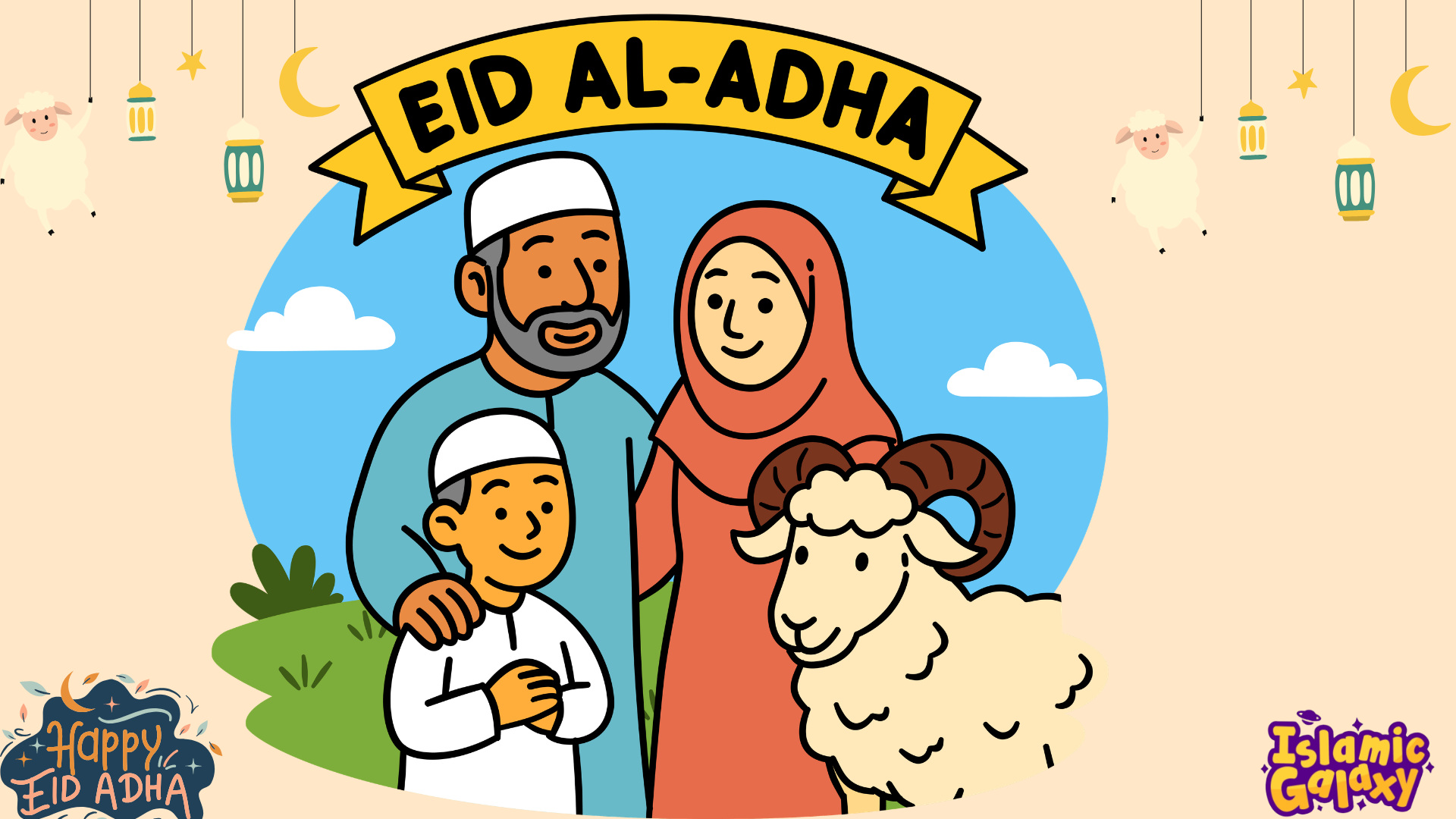
Eid al-Adha — عيد الأضحى — is "the Festival of Sacrifice." Most people know that much. What gets lost sometimes is the story underneath it.
Prophet Ibrahim (AS) was commanded in a dream — and for prophets, dreams are revelation — to sacrifice his son Ismail. He told Ismail what he had seen. Ismail's response was not protest. He said: do what you've been commanded. You'll find me patient. And Ibrahim proceeded.
At the moment he was about to carry it out, Allah called to him. He had already fulfilled the vision. A ram was sent in Ismail's place. Both father and son had passed something that most of us struggle to even imagine — the complete willingness to give up what you love most, for no reason other than Allah said so.
The Qurbani Muslims perform on these days isn't a cultural holdover. It's a direct line back to that moment — a yearly, physical re-commitment to the same principle.
For children learning this story from the Quran itself, Islamic Galaxy's Quranic video series covers Surah As-Saffat and the sacrifice narrative in a way kids actually sit and watch.
How Is Eid al-Adha Celebrated?
No two families do Eid exactly the same way, but there's a recognizable shape to it.
The Eid prayer is where the day begins. People get up early, take ghusl, put on their best — or new — clothes, and go to the masjid or an open prayer ground. There is something about arriving for Fajr or just after and seeing hundreds of people already there that sets the tone for the whole day.
Qurbani follows the prayer. A sheep, goat, cow, or camel is sacrificed in the name of Allah. The meat is divided into three: one third stays with the family, one third goes to relatives and friends, one third goes to people in need. In many families this is handled by a local butcher or an overseas charity — in others, it's still done traditionally. Either way, the intention is the same.
Family time takes over the rest of the day. Food, visits, children collecting Eidi from every aunt and uncle in the room. The table is different in every culture – biryani in one home, mansaf in another, a whole roasted lamb somewhere else – but the generosity is the same.
The Takbeer is said throughout this whole time, from Fajr of 9th (Day of Arafah) to Asr on the 13th: Allahu Akbar, Allahu Akbar, la ilaha illa Allah, Allahu Akbar, Allahu Akbar, wa lillahi al-hamd. From the masjid, from cars, from the phone of the uncle who always puts it on speakerphone. It separates the whole period from ordinary time.
If you're looking for ways to keep children connected to the spirit of the season — not just the food and the gifts — Islamic Galaxy's halal entertainment for kids is worth bookmarking before the day arrives.
Conclusion
Eid al-Adha isn't just a holiday that happens to fall near Hajj season. It's the same story, observed from home — Ibrahim's submission, Ismail's patience, the ram that came as mercy. The prayer, the Qurbani, the generosity built into how the meat is shared — none of it is arbitrary. It all points back to the same thing: that submission to Allah is the foundation, and that foundation holds even when it costs you something.
That's worth more than a date on a calendar. But June 26 is probably a good one to mark anyway.
FAQs
Is there a specific day when Eid al-Adha falls every year? No. Eid al-Adha is a movable festival celebrated about ten to eleven days before the previous year. This is due to the fact that the Islamic calendar is approximately ten days shorter than the Gregorian calendar, and therefore, after thirty-three years, it will circle the seasons once again.
Is Qurbani compulsory for all Muslims during Eid al-Adha? No. Qurbani is obligatory for all Muslim adults who possess enough means for it. People who lack sufficient resources are exempted from its fulfillment. Even the children are not obligated to perform Qurbani.
Is it possible to observe Eid al-Adha without performing Qurbani? Yes, absolutely. Although Qurbani is an independent obligation, others like praying, reciting takbeers, family gatherings, and expressing gratitude are rights for all.