
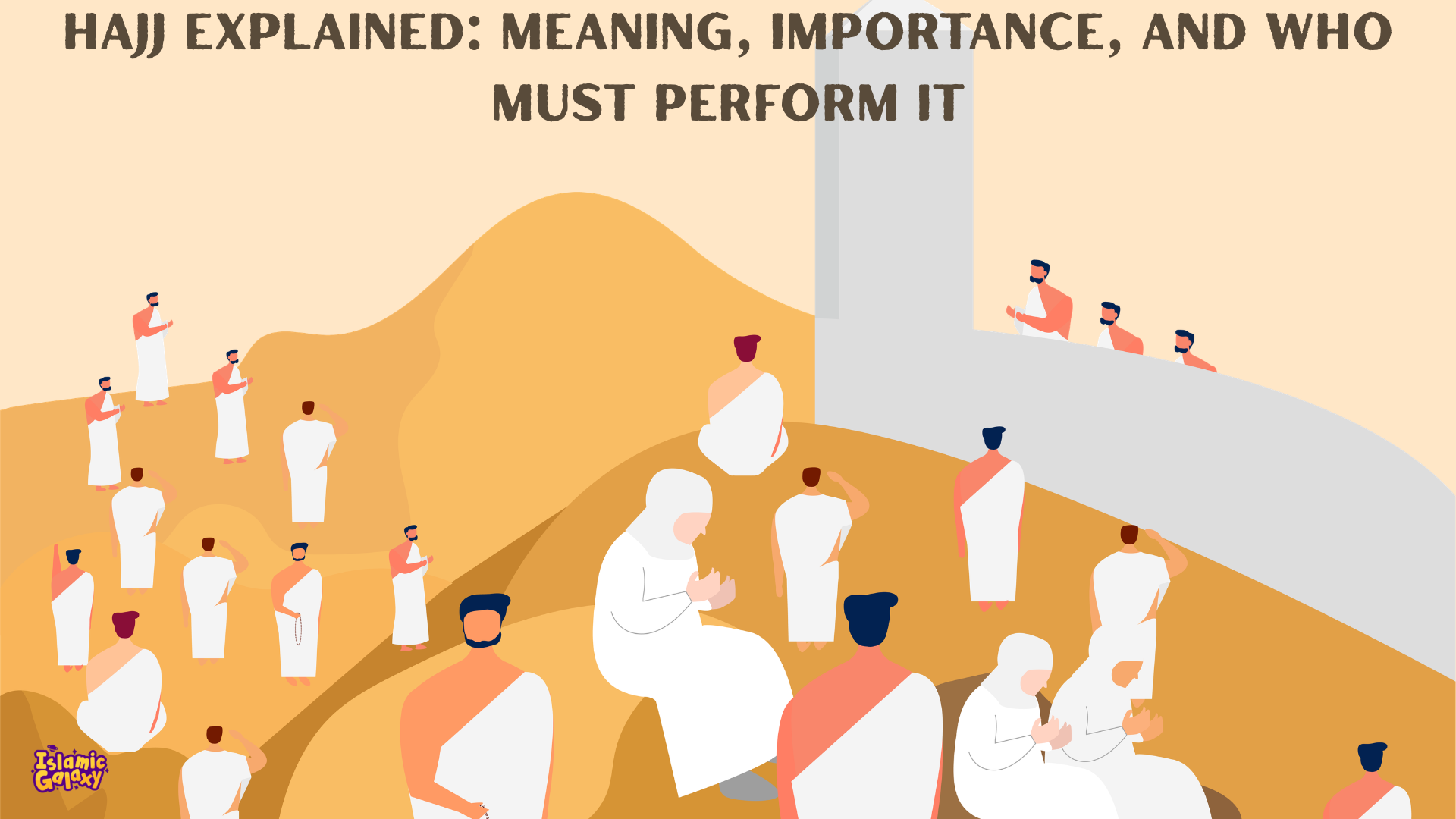
Millions of Muslims from all parts of the world perform the Hajj in Makkah every year. In this way many people come from all over the world to Makkah on a yearly basis dressed in plain white clothing and are unable to communicate verbally but all of them have come together and have the same reason for being there.
This is an explanation of what the pilgrimage is and why it is important to explain to children or to anyone who wants to learn more about the meaning of the pilgrimage Hajj.
What Is Hajj?
Hajj is a pilgrimage to the Holy City of Mecca, performed annually, and one of the Pillars of Islam (an obligation for all Muslims who can afford it financially and have no ailment that would prevent them from going).
The Hajj takes place in the month of Dhull-Hijjah ( the month of Hajj or pilgrimage ) . Dhull-Hijjah is the 12th month of the Islamic calendar . The blessings gained on the 8th to 13th of Dhul-Hijjah while travelling to the ka’bah on these days are greater than any other time.
For children learning about the five pillars, Islamic Galaxy's Islamic games make the foundations of Islamic practice memorable and interactive.
Why Is Hajj Important?
Hajj is the world’s biggest annual gathering, with more people than any other event on the planet. Hajj is a symbol of the unity of the ummah (the collective Muslim community) in submission to Allah, regardless of wealth, status or nationality. Everyone performing the Hajj wears the same clothes called ‘ihram’. So everyone there will be dressed the same.
The Hajj pilgrimage is the recollection of the trials and tribulations of Abraham (AS) and his family such as: the sacrifice of Isaac (AS), the search of Hagar (AS) for water, and the building of the Ka'bah (House of Worship created by Allah) Although they are viewed as historical acts, they are alive through submission to Allah at the sanctuaries of the first ones to submit to Him.
Who Must Perform Hajj?
Hajj is obligatory (fard) on every Muslim who meets four conditions:
- Muslim: the person must be Muslim
- Adult: the person must be of age (post-puberty)
- Sane: the person must be mentally competent
- Capable: physically healthy enough to make the journey, and financially able to fund it without hardship
If any of these conditions is not met, Hajj is not obligatory for that person. Children are not obligated, though they may attend with a parent as a blessed act.
The Spiritual Weight of Hajj
The Prophet ﷺ said: "Whoever performs Hajj for Allah's sake and does not engage in sexual relations, commit sins, or dispute unjustly — he will return as pure as the day his mother gave birth to him."
This is why Hajj is considered a complete spiritual reset. The physical difficulty, the crowd, the repetition of rituals — all of it strips away the ordinary and forces a focus on
nothing but Allah.
For stories that bring the history of Hajj and Ibrahim (AS) to life for young children, Islamic Galaxy's Quranic videos include content about the Ka'bah and Zamzam drawn directly from Quranic accounts.
Conclusion
The largest, single, greatest human gathering on the planet occurs every year during the Hajj pilgrimage to Mecca. The entire community of Muslims (the Ummah) will gather in a single place as equals before God. There will be no distinctions made on the basis of wealth, position or nationality during the pilgrimage; everyone will wear the same simple white garments known as Ihram.
The pilgrimage recreates the trials endured by Prophet Ibrahim (peace be upon him) and his family; (the willingness to sacrifice his son; the search of his wife for water; the building of the Kabbah) that have occurred and can still be observed at the same geographical location where they originally occurred, and provides a living memory through performance of these actions of marching to Hajj, submitting to God, and following in the footsteps of those who demonstrated true submission to God.
FAQs
Can Hajj be performed on behalf of someone who has passed away?
Yes. If a person died without being able to perform Hajj despite being obligated to do so, a family member can perform it on their behalf (Hajj al-badal). This is a recognized practice in Islamic jurisprudence.
What is the difference between Hajj and Umrah?
Hajj is obligatory, time-specific (Dhul Hijjah), and involves a full set of rituals. Umrah is a voluntary, shorter pilgrimage that can be performed any time of year. They share some rituals but are distinct acts of worship.
What does ihram mean?
Ihram refers to both the sacred state a pilgrim enters before Hajj begins, and the white unsewn garments men wear during it. Women dress in modest, regular Islamic clothing. Entering ihram involves specific intentions and prohibitions.
Is there an age requirement for Hajj?
There is no minimum age, but children are not obligated. Adults must be of post-pubescent age for the obligation to apply. If a child performs Hajj, it is a blessed act but doesn't count as the obligatory Hajj when they grow up.