
Let me start by saying something nobody really says in these guides: Hajj is not tidy.
Every "step by step" article makes it sound like a neat sequence. Do this, then this, then this. And yes, there is a sequence — a real and important one — but the experience of it is loud and hot and emotional and crowd-filled and deeply disorienting in the best possible way. I want you to understand the steps AND have some sense of what those steps actually feel like to go through.
So that's what this is. A proper walkthrough, in order, but honest about it.
What Is Hajj and Why Does It Matter So Much
Hajj is the annual Islamic pilgrimage to Makkah. It's one of the five pillars of Islam — not a bonus act of worship, an actual pillar — meaning it's obligatory for every Muslim who is physically healthy enough and financially able to make the journey. Once in a lifetime.
It happens every year during Dhul Hijjah, the last month of the Islamic lunar calendar. Around two to three million Muslims travel from every country on earth to be there.
Here's the thing that I think gets lost when people describe Hajj as "a religious obligation": it is also one of the most profound things a human being can do. The rituals are not arbitrary. Every single one traces directly back to the family of Ibrahim — his wife Hajar, his son Ismail — and the tests they each faced. You are not just performing rituals. You are walking in footsteps that are thousands of years old and still warm.
If you want the full backstory on Ibrahim and why his family is at the center of all of this, Islamic Galaxy has a good history of Eid al Adha that covers it simply and well.
Prepare Before You Go — Really Prepare
Most guides skip this part or treat it like a packing checklist. It's more than that.
Physical preparation. Hajj involves serious walking. Not a stroll — some days pilgrims cover 15 to 20 kilometres on foot in heat that can exceed 40°C. People who underestimate this pay for it on day two or three of the ritual days when their body just stops cooperating. Walk daily in the weeks before. Build stamina. This is not optional advice.
Spiritual preparation. Many scholars say you should arrive at Hajj having made tawbah — genuine repentance — settled debts, and repaired what can be repaired with people in your life. Hajj is, in part, a total reset. You come in carrying things you want to put down. Preparing for that before you arrive makes the putting down easier.
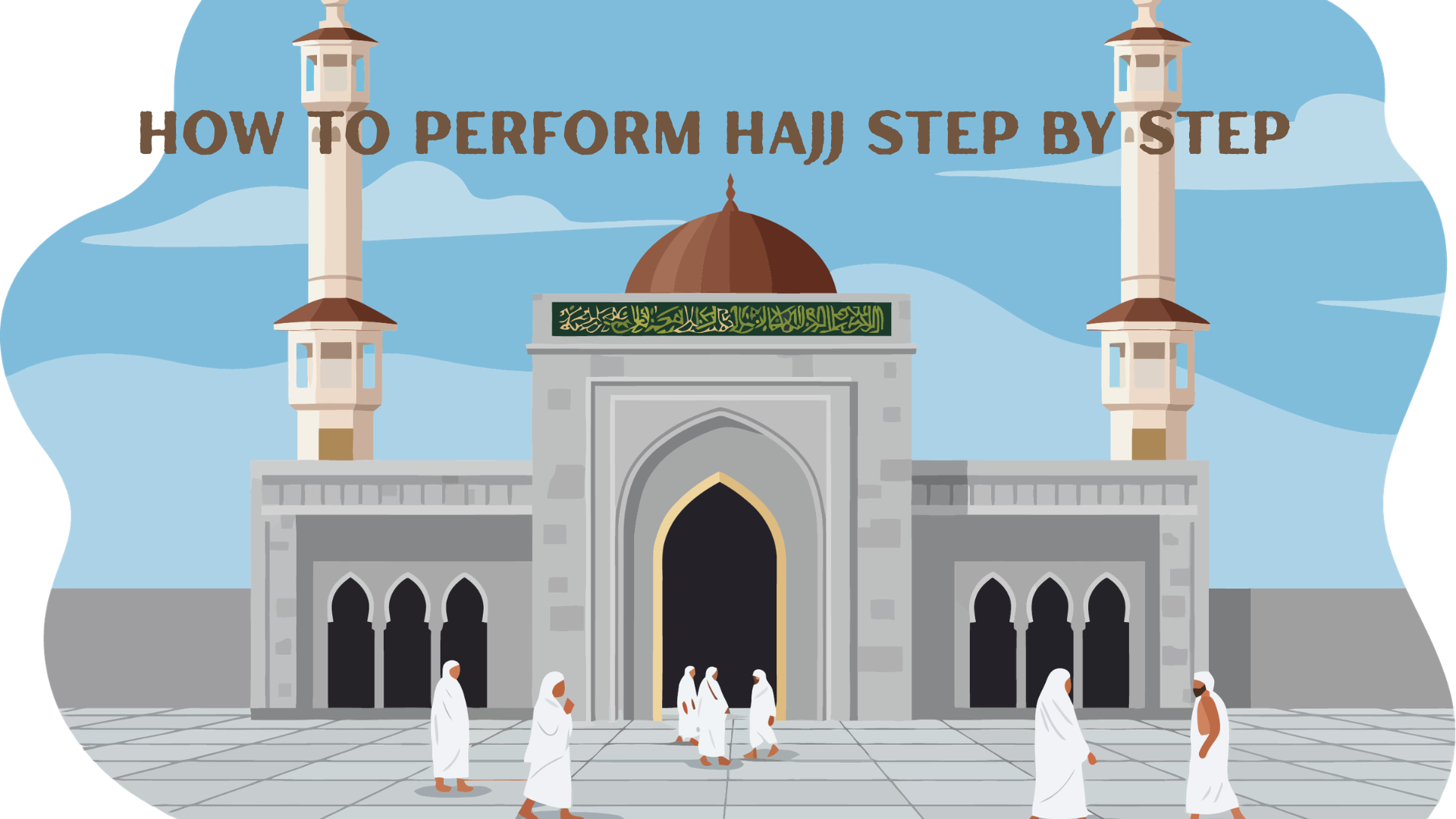
Ihram garments. Men wear two plain, white, unstitched cloths — nothing more. Women wear modest, loose clothing. No perfume for anyone. No markers of wealth or status. The whole point is equality. In ihram, a billionaire and a farmer are dressed the same. That's intentional and it matters more than it sounds.
Step 1 — Entering Ihram at the Miqat
The Miqat is a set of boundary points around Makkah. You cannot cross into the sacred zone without entering the state of ihram first.
To do this: perform ghusl (full ritual wash), put on your garments, make your niyyah (intention) for Hajj, and begin the Talbiyah.
The Talbiyah is this:
Labbayk Allahumma labbayk. Labbayka la sharika laka labbayk. Innal hamda wan ni'mata laka wal mulk. La sharika lak.
Which means — Here I am, O Allah, here I am. Here I am, You have no partner, here I am. All praise, grace, and sovereignty belong to You. You have no partner.
You will say this on repeat. In your head, out loud, on the bus, half asleep. It becomes something like a heartbeat by the time you reach Makkah.
Once in ihram: no cutting hair or nails. No perfume. No marital relations. No hunting. No arguments, no harsh speech. The restrictions are real and the point of them is to strip away normal life completely. Hajj gets all of you, not whatever you have left over after everything else.
Step 2 — Tawaf al-Qudum: First Sight of the Kaabah
When you arrive in Makkah, you go straight to Masjid al-Haram to perform Tawaf al-Qudum — the arrival circumambulation of the Kaabah.
Tawaf is circling the Kaabah seven times, counterclockwise, beginning at the Black Stone in the eastern corner. If you can touch or kiss the Black Stone, you do. If the crowd makes it impossible — and it often does — you face it and point as you pass.
I want to say something about seeing the Kaabah for the first time. People try to describe it and mostly fail. What they tend to land on is this: something happens. Something that doesn't have a rational explanation. People who travelled for 20 hours and haven't slept and are sweaty and disoriented — they see the Kaabah and they cry. Immediately. Without meaning to. This is not an exaggeration; it is a consistent report from millions of people across centuries.
After Tawaf: two rakat near the Station of Ibrahim (Maqam Ibrahim), then drink from Zamzam — the well that burst from the ground when Hajar was running desperately between two hills looking for water for her infant son. The same water. Still there.
Step 3 — Sa'i Between Safa and Marwa
Sa'i means walking seven times between two hills called Safa and Marwa, now enclosed inside the mosque.
This is Hajar's walk. She ran between these hills searching for any sign of water or help. Seven times she went back and forth. Nothing each time. And then water came out of the earth beneath her son's feet.
Walking Sa'i knowing that story is a completely different experience from walking it without knowing it. You're not doing a ritual. You're following someone who ran in desperation and found that desperation was not the end of the story.
Step 4 — The 8th of Dhul Hijjah: Going to Mina
This is officially day one of Hajj. Pilgrims travel from Makkah to the valley of Mina, about 8 kilometres away, where a massive tent city has been constructed. White tents as far as you can see, every one assigned to a group of pilgrims.
The 8th is quiet. Five daily prayers, some of them shortened. Quran. Rest. Sitting with people you've never met before who are here for exactly the same reason you are. There's a specific feeling to Mina on this night that returned pilgrims describe consistently — a collective stillness, millions of people waiting together — and it's hard to convey unless you've sat in it.
Step 5 — The 9th of Dhul Hijjah: Arafat
"Hajj is Arafat." That's not a summary of the Prophet's ﷺ teaching — it is the teaching, said exactly that directly. If a pilgrim misses Arafat, the Hajj is not valid. No exceptions, no workarounds.
After Fajr in Mina, pilgrims travel 14 kilometres to the plain of Arafat and perform wuquf — the standing — from around midday until sunset. Hours of prayer and dua. Hours of complete focus on nothing except asking Allah for what you need and acknowledging what you've done wrong and hoping, seriously hoping, for mercy.
Jabal al-Rahmah — the Mountain of Mercy — stands in the plain. The Prophet ﷺ delivered his Farewell Sermon there. Pilgrims pray around and on it. Many say Arafat is the most emotionally intense experience of their lives. The closest they've ever felt to God. That sentence appears in accounts of Hajj from people across very different backgrounds, in different decades, from different countries. Something happens there.
The 9th is also the Day of Arafah for Muslims who aren't on Hajj — fasting this day wipes out sins from two years, the one before and the one coming.
After sunset, everyone moves to Muzdalifah — open ground between Arafat and Mina. Maghrib and Isha are prayed together, people sleep under the open sky, and small pebbles are collected here for the next days.
Step 6 — The 10th of Dhul Hijjah: Eid al Adha in Mina
Three things happen this day in sequence and it is the hardest, most packed day of the whole pilgrimage.
Rami al-Jamarat. Seven pebbles thrown at the largest of three pillars — the Jamarat. This is Ibrahim's act of throwing stones at Shaytan, who appeared three times trying to stop him from following Allah's command. The crowds here are enormous. Really enormous. The Saudi government has built a multi-level structure around the Jamarat to manage the flow of pilgrims but it still requires serious patience and care.
Qurbani. An animal is sacrificed — sheep, goat, cow, or camel. This commemorates Ibrahim's sacrifice, when Allah sent a ram to replace Ismail at the last moment. The meat goes to people who need it.
Halq or Taqsir. Men shave their heads completely or cut their hair short. Women trim a small amount. Ihram restrictions partially lift. A lot of pilgrims — a surprising number of them — say the head shave is when it becomes real. Something physical completing. Something you can feel.
Pilgrims return to Makkah for Tawaf al-Ifadah, which is a pillar of Hajj and not optional. After this Tawaf, all ihram restrictions are fully lifted.
Step 7 — 11th and 12th: The Days of Tashriq
Back in Mina for two more days. Each day, pilgrims stone all three Jamarat pillars — seven pebbles each, 21 stones per day. Between stonings: eating, rest, dhikr, sitting with the people in your group, recovering.
Pilgrims who want to leave early must finish the 12th day stoning before sunset. Anyone still in Mina after sunset on the 12th has to stay and complete the 13th.
Step 8 — Tawaf al-Wada: The Goodbye
Just before leaving Makkah, pilgrims perform Tawaf al-Wada — the farewell Tawaf. One last circle of the Kaabah.
Most pilgrims don't want to leave. They stand at the mosque exits looking back. Some can't stop crying. Some just stand there for a long time not moving. The story of Hajj tends to end here, at the door, not wanting to go through it.
Let that happen. Don't rush this part.
What Comes After
The Prophet ﷺ said that a person who completes Hajj properly returns home like the day they were born — free of sin. New.
That's the point of all of it. Every step, every crowded road, every night on the ground, every stone thrown at a pillar. It's all pointed at that.
Conclusion
Hajj is five ritual days that people spend the rest of their lives trying to describe. Every step is a story. Every crowd is a community. Every stone thrown is a choice being made, the same choice Ibrahim made, which is: not Shaytan, not fear, not comfort — Allah.
If you're preparing to go, may Allah make it easy. If you're years away from being able to, knowing it this well is its own kind of closeness to it.
You can learn so much more on Islamic Galaxy, you can also download the app now.
FAQs
Do you need to speak Arabic to do Hajj? You need the Talbiyah and standard prayer phrases — but fluency isn't required. Pilgrims of all languages complete Hajj successfully every year. Most tour groups include guides who help throughout.
Can children go to Hajj? Yes, but it won't count as their obligatory Hajj. They'll need to go again as adults when they're physically and financially able.
What if you get sick during Hajj and can't finish a ritual? Islamic jurisprudence has specific rulings for this depending on which ritual was missed. Ask a knowledgeable scholar or your Hajj group leader directly — the answer varies by situation.