
The first time someone properly explained ihram to me I was sitting in a pre-Hajj preparation class, notebook open, thinking this would be straightforward. Two white cloths for men, modest dress for women, a list of things not to do. How complicated could it be?
Pretty complicated, as it turns out. Not in a discouraging way — in a "this is actually a deeply thought-through system with real reasons behind every rule" kind of way. The more I understood the why behind each restriction, the more sense the whole thing made.
This guide covers the ihram rules properly — what ihram actually is, how you enter it, what becomes forbidden, and what to do if something goes wrong. Whether you're preparing for Hajj yourself, explaining it to your children, or just trying to understand what the pilgrims you see on television are doing — this is the place to start.
What Ihram Actually Is
People often think of ihram as just the clothing. The two white unstitched cloths that male pilgrims wear. But the clothing is only the outer sign of something bigger.
Ihram is a state. A state of ritual purity and complete focus, entered intentionally, that changes how you're allowed to behave until it's lifted. You don't just put on white fabric and carry on as normal. Entering ihram means stepping out of ordinary life and into something else entirely — a heightened state of awareness, worship, and restraint.
The word ihram shares a root with the Arabic word haram, meaning forbidden or sacred. Entering ihram makes certain things forbidden that were previously allowed. It also marks you as someone who has set ordinary life aside temporarily for a higher purpose.
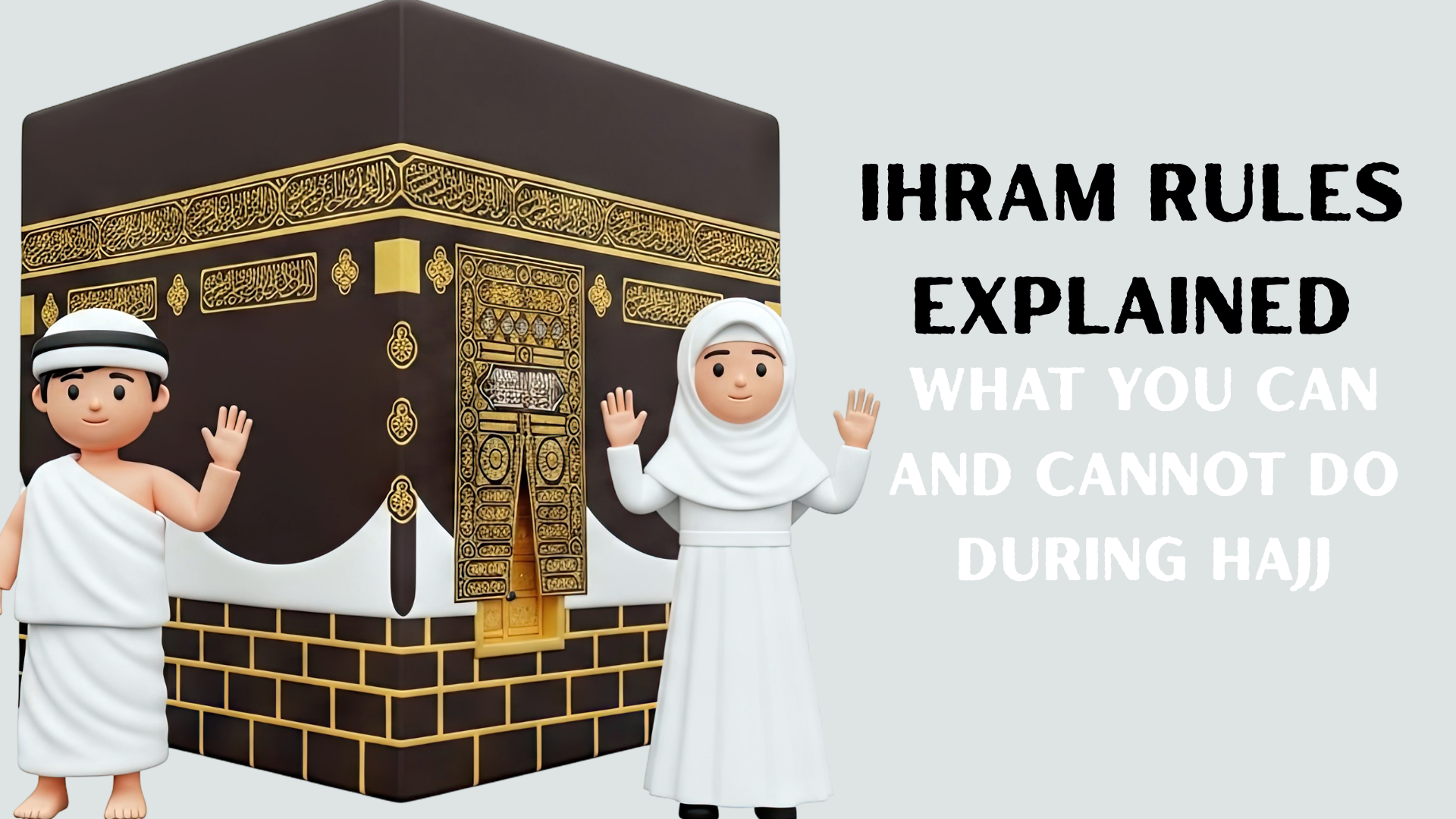
For men, the visual marker is the two white unstitched cloths — the rida (upper) and the izar (lower). For women, it's modest, loose-fitting clothing that covers everything except the face and hands. No specific colour is required for women, though white is common.
The equality dimension matters here and gets said a lot but deserves to be said again: in ihram, you genuinely cannot tell a king from a street vendor. Same fabric, same restrictions, same state. Two million people dressed identically, all carrying the same rules. That is a deliberate statement about what Hajj is and what it isn't.
How to Enter Ihram
You don't just put the clothes on. There's a process.
Step 1 — Ghusl. Perform a full ritual wash before entering ihram. This is strongly recommended and considered by many scholars to be obligatory.
Step 2 — Clip nails and remove body hair. Because you won't be able to do this once you're in ihram, doing it beforehand is important.
Step 3 — Apply perfume to the body (not the garments). This is the last time you'll wear fragrance until ihram is lifted. It's permissible to apply it to your skin before putting on the ihram clothes — even if the scent lingers during Hajj, that's fine. What's not allowed is applying it after entering ihram.
Step 4 — Put on the ihram garments.
Step 5 — Make the niyyah. The intention for Hajj, made at or before the Miqat — the boundary point around Makkah that pilgrims must not cross without entering ihram. There are different Miqat points depending on which direction you're travelling from.
Step 6 — Begin the Talbiyah.
Labbayk Allahumma labbayk. Labbayka la sharika laka labbayk. Innal hamda wan ni'mata laka wal mulk. La sharika lak.
Here I am, O Allah, here I am. Here I am, You have no partner. All praise and grace belong to You, and all sovereignty. You have no partner.
Once you've said the Talbiyah with intention, you're in ihram. The restrictions apply immediately.
What Is Forbidden in Ihram
This is the part people most want to know. The list is specific and for good reason — violating ihram restrictions isn't a small thing, and some violations require a fidya (expiation).
Cutting Hair or Nails
Forbidden for the entire duration of ihram. This includes trimming, shaving, plucking — any deliberate removal of hair from anywhere on the body. Nails too. If a hair falls out naturally or breaks, that's fine. Deliberate cutting is not.
Using Perfume or Fragrance
No perfume, scented soap, scented lotion, deodorant with fragrance. Unscented alternatives are fine. This extends to scented items in general — you wouldn't hold a bunch of flowers to smell them intentionally, for example.
Sexual Relations
Forbidden. Completely. Any sexual activity between spouses is prohibited while in ihram. This is one of the more serious restrictions — violating it in a major way can invalidate Hajj entirely, which is why it's worth naming clearly.
Marriage Contracts
Getting married — or conducting a marriage on behalf of others — is not permitted while in ihram.
Hunting Wild Animals
Forbidden to hunt land-based wild animals or assist anyone else in hunting. Fishing is permitted. Already-prepared food, including meat, is fine.
Cutting or Uprooting Plants Within the Haram
Within the sacred boundaries of Makkah specifically, cutting trees or plants is forbidden. This extends beyond the ihram state itself — it's a rule of the Haram.
What Is Forbidden for Men Specifically
Covering the Head
Men cannot cover their heads. No hat, no cap, no hood, nothing on top of the head. Holding an umbrella for shade is fine — it's not touching the head. But a hat is not. This catches people off guard in hot weather more than almost anything else on this list.
Wearing Stitched Clothing
Men cannot wear any stitched garments. No shirts, no trousers, no socks, no underwear. The two unstitched cloths are it. Sandals are allowed — open ones that expose the top of the foot are required by some scholars, though this point has variation.
Women do not have the same restrictions around stitching — their modest clothing can be their regular clothing.
What Women Cannot Do
Covering the Face
Women in ihram do not cover their faces with a niqab or veil. This is a specific ihram ruling — in normal life, niqab may be a woman's practice, but during ihram the face must be uncovered.
Wearing Gloves
Hands must remain uncovered. If a woman wants to cover her hands for modesty, she can use her sleeves or a cloth she holds — but fitted gloves are not permitted.
What Is Allowed — Because This Gets Confusing
People sometimes overcorrect and become afraid to do anything normal while in ihram. To be clear:
- Wearing a money belt or bag is fine — it's not stitched clothing
- Wearing glasses is fine
- Using an umbrella for shade is fine
- Washing yourself with unscented soap is fine
- Changing your ihram cloths if they get dirty is fine
- Scratching your head gently is fine — if a hair falls out in the process, you haven't violated anything
- Killing insects that are dangerous (scorpions, for example) is permitted
- Looking in a mirror is permitted
- Eating and drinking normally is permitted
Sa'i Between Safa and Marwa — Ihram and the Ritual
Sa'i — the walking between Safa and Marwa seven times — is performed while in ihram during Hajj. It's one of the required rituals and it commemorates Hajar's desperate search for water when she and infant Ismail were left in the desert valley of Makkah.
She ran. Seven times between those two hills. Nothing each time. And then Zamzam burst from the earth.
The ihram state you're in during Sa'i connects to the humility of that moment. You've stripped away the normal markers of your life — your clothes, your fragrance, your comfort zones — and you're walking in the footsteps of a woman who had stripped everything away too, not by choice, but by circumstance, and who held onto faith when faith was all she had left.
Sa'i starts at Safa and ends at Marwa. Men are encouraged to jog lightly between two green lights that mark a specific section — this is sunnah, not obligatory. Women walk at their own pace throughout.
What Happens if You Break an Ihram Rule
Mistakes happen. People forget. The rules are detailed and the environment of Hajj is intense and disorienting. Islamic jurisprudence accounts for this.
Fidya is the expiation for most ihram violations. The standard fidya is a choice between three options: slaughtering an animal, fasting three days, or feeding six poor people. The scholar opinion you follow may affect which violations require which expiation — this is worth clarifying with a knowledgeable source before you travel.
Accidental violations are treated differently from deliberate ones. Someone who cuts a hair by accident has a lighter ruling than someone who does it intentionally.
Ignorance is also taken into account in many cases. If you genuinely didn't know something was forbidden, scholars generally apply leniency.
The key is not to panic if something happens. Know the rules before you go, but also know that the system has provisions for being human.
When Does Ihram End
Ihram is lifted in stages on the 10th of Dhul Hijjah — Eid al Adha — after the following are completed:
- Rami al-Jamarat (stoning the largest Jamarat pillar)
- Qurbani (the sacrifice)
- Halq or Taqsir (shaving or cutting the hair)
After these three, most restrictions lift. This is called the partial tahallul — men can put on regular clothes, both men and women can use perfume again, and most normal life resumes. The one restriction that remains is sexual relations between spouses.
Full tahallul — complete lifting of all ihram restrictions — happens after Tawaf al-Ifadah and Sa'i are completed. At that point, everything is permitted again.
Conclusion
Ihram is one of those things that looks simple from the outside — two white cloths, some rules — and turns out to be a carefully constructed framework for transforming how you move through the world for a few days. Every restriction has a reason. Every rule points toward the same thing: leaving ordinary life completely behind and being, for the duration of Hajj, nothing except a servant standing before Allah.
Understanding ihram before you go — or before someone you love goes — makes the whole experience make more sense.
For more on the full Hajj journey, the story behind Eid al Adha, and everything connected to this season, visit Islamic Galaxy. The guides there are written to be accessible for the whole family.
FAQs
Can women wear their normal modest clothing in ihram? Yes — women don't have the same stitching restrictions as men. Regular modest clothing is fine, as long as the face and hands remain uncovered during ihram.
What if I accidentally use scented soap during ihram? An accidental, unknowing violation is treated with leniency by most scholars. If it was genuinely accidental, make istighfar and continue. Deliberate violations are a different matter.
Does ihram apply only during Hajj or during Umrah too? Both. Ihram is required for both Hajj and Umrah. The same restrictions apply in both cases, though the ihram for Umrah is lifted after completing Tawaf and Sa'i, which is a shorter process than Hajj.