
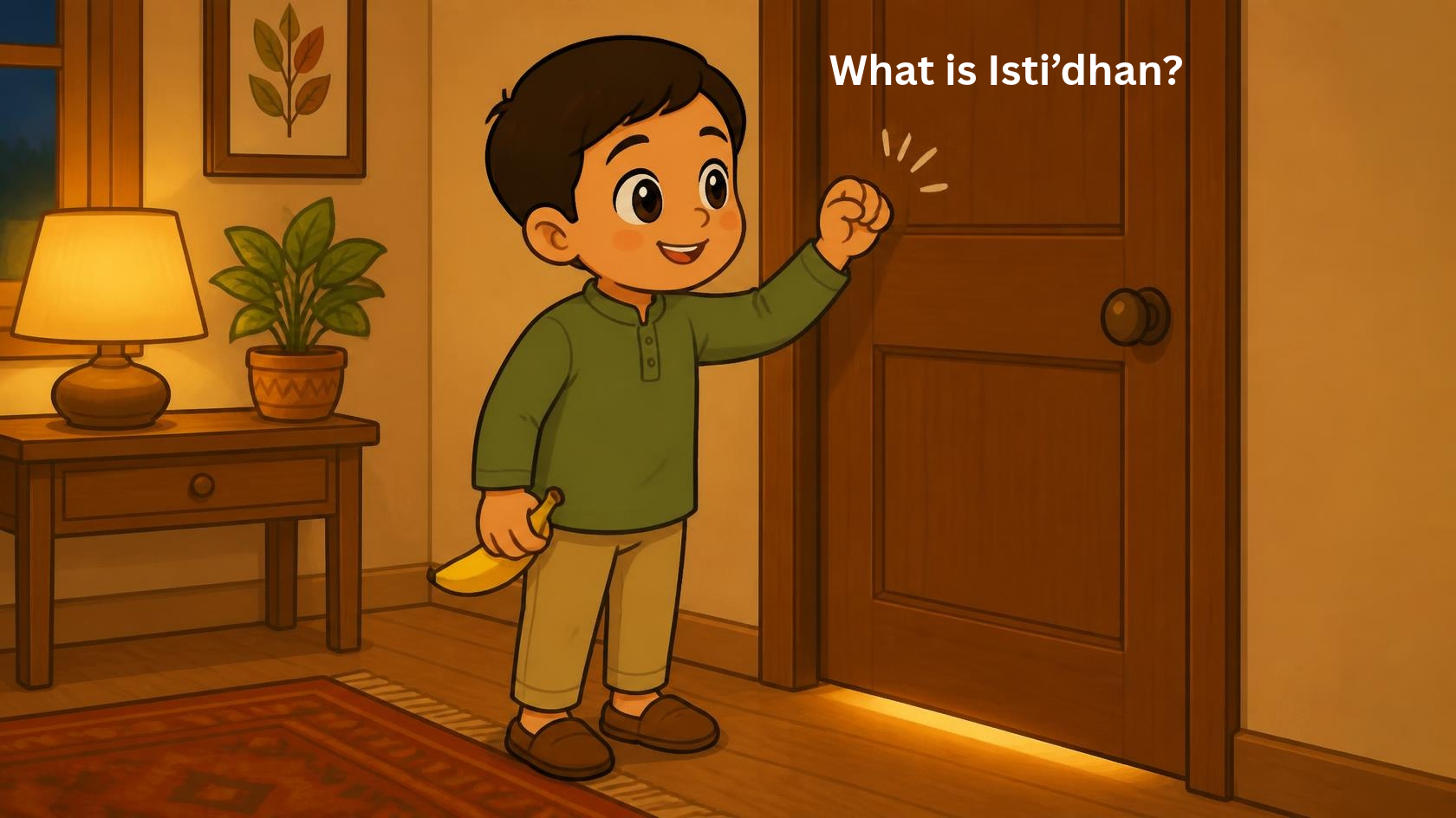
My nephew walked into my room while I was on a work call. No knock, no word. He just stood there holding a banana, completely serious, waiting for me to notice him, and my whole team watched this happen on camera. I laughed, he laughed, I muted myself and said "next time, you knock." He asked what knock means.
Which is when I realized nobody had ever actually taught him.
The word
Isti'dhan means asking permission before you come in. The Arabic covers the full manners around it, so knocking, greeting, waiting, accepting a no. Surah An-Nur puts it straight: believers, don't enter houses other than your own until you've asked permission and greeted the people inside. Privacy gets treated as something real in Islam, not a nicety.
What you actually say
There's a hadith in Abu Dawud where a man came to the Prophet Muhammad, peace be upon him, and said "may I come in?" The Prophet told someone to go and teach him: say Assalamu alaykum, may I come in. So the greeting goes first, then the question.
There's another one in Bukhari and Muslim about someone who knocked, and when asked who it was just said "me", and the Prophet didn't like that. Say your name. So my nephew now says "It's Hamza, may I come in?" and not just a mysterious "it's me." Kids find this hilarious, and they remember it.
Three tries, then leave
Same collection of hadith. You ask three times. If you're allowed in, go in. If not, go back. No sulking, no pushing at the door.
That last bit is where the real lesson sits. A no is allowed. Houses belong to people, people aren't always ready, and the right answer is "okay" and walking away. I've met adults who could do with relearning this.
Also, stand slightly to the side of the door and not straight in front of it, which Abu Dawud reports. The point is you shouldn't be looking in.
Inside the family too
Surah An-Nur covers children specifically. There are three times of day when little ones should knock before coming into their parents' room: before Fajr, at midday when people rest and change, and after Isha. The Quran calls them times of privacy.
So at home the rule is simple. Parents' door closed, the child knocks. Child's door closed, you knock too. Teaching kids is mostly modeling, and nothing teaches knocking like being knocked on.
It quietly protects them as well. A child who learns that every closed door gets a knock learns that their own door, their own body, their own space gets respected too. That matters more than people realize.
What it looked like at our house
We had a bad stretch where my cousins' kids kept barging into each other's rooms and the screaming was constant. Then someone made a "Knock First" sign out of cardboard and glitter. It worked better than three years of yelling, and I'm only slightly bitter about it.
Role-play helped too. One child plays the guest, one the host, swap after two minutes. Our activities for kids are good for this kind of thing, since learning manners through acting it out sticks far better than a talk.
Beyond the house
The same idea carries to places of worship, where we enter somebody else's space and a different set of manners applies. Our post on the adab of the mosque goes into that side of respect.
Conclusion
A week later my nephew knocked on my door, very softly, three knuckle taps, and whispered "Salam. It's Hamza. May I come in?" He had the banana again. I let him in, obviously, and treated it like the most formal meeting of my life. For more videos, games and activities that help kids learn everyday manners, you'll find everything at Islamic Galaxy.
FAQs
What is isti'dhan in Islam? Isti'dhan means asking permission before entering someone's room or home. It includes greeting with salam, saying who you are, asking to come in, and leaving politely if the answer is no. It protects everyone's privacy.
How many times do you knock in Islam? The hadith teaches asking up to three times. If you get permission, you go in. If there's no answer or you're told no, you go back without anger, because the home belongs to its people and they may not be ready.
Do kids need permission to enter their parents' room? Yes. The Quran mentions three times of privacy for children: before Fajr, at midday rest, and after Isha. Teaching them to knock builds respect for privacy in both directions, and shows children their own space matters too.