
When you first begin reading the Qur’an with tajweed, some ideas feel easy to grasp, but others, like leen letters, can seem confusing at first. Many people learning Tajweed ask the same questions: What are leen letters? Why do they sound soft? Why does the sound get longer in some words but not others? And what's the difference between "leen" and "madd leen"?
If you've ever had these questions, this is the right place for you. This article is like having a teacher explain the concept to you, one step at a time — in a clear, calm, and practical way.
By the end, you’ll have a full understanding of leen letters in Arabic, how they appear in the Qur’an, how they differ from other types of madd, and how to say them with confidence.
What Are Leen Letters?
In simple terms:
Leen letters (حروف اللين) are two letters in Arabic:
- و (waw)
- ي (ya)
But they only become leen letters when:
- They are saakin (وْ or يْ)
- The letter before them carries a fatḥa (َ)
That’s it.
So a “leen letter” is not just the letter itself — it’s a letter in a specific condition.
Examples from the Qur’an:
- خَوف → waw is saakin + preceded by fatḥa
- بَيت → ya is saakin + preceded by fatḥa
- قَول
- خَير
In all these words, the sound of waw or ya becomes soft, smooth, and relaxed, almost like you are gliding through the word. That smooth flow is what gives the leen letters their name. There are so many ways that can make learning easier and more fun. Check out our games that make learning more fun and engaging.
The word “leen” (لين) in Arabic literally means:
- softness
- ease
- flexibility
This perfectly describes the sound of these letters in tajweed.
Why Are They Called “Soft” Letters?
When you pronounce وْ and يْ after a fatḥa, there is no tightness in the mouth, no pushing of air, and no pressure on the vocal cords.
Instead, the sound flows, giving the recitation a calm, beautiful rhythm.
If you pronounce “خَوف”, your mouth opens naturally on the fatḥa of خَ (kha), and then slides smoothly into the waw sound. There’s no hardship or force — only softness.
This softness is unique to the leen letters in Arabic pronunciation.
The Difference Between Leen Letters and Madd Letters
Many students confuse leen letters with madd letters. They look similar but are not the same.
Let’s break it down.
Madd Letters (حروف المد):
- ا مفتوحة قبله فتحة
- و مضموم قبله ضمة
- ي مكسور قبله كسرة
Madd letters naturally create a long vowel sound (2 counts or more, depending on rules).
Leen Letters:
- Only و and ي
- Must be saakin
- Must be preceded by a fatḥa
And their sound is not long by default. It is soft rather than stretched.
What Is Madd Leen?
Madd Leen occurs when:
- A leen letter appears
- The next letter is a sukoon caused by a stop (waqf)
- Usually, at the end of a word
In this case, the sound stretches 2–6 counts depending on the recitation style.
Examples:
- خَوفْ
- قَومْ
- بَيتْ
- شَيءْ
When you stop on these words, you are allowed — and expected — to stretch the leen sound. This is Madd Leen's letters, and it is one of the most common Madd types in Qur’anic recitation.
Why Are Leen Letters Important in Tajweed?
Learning how to properly pronounce the leen letters in Tajweed is very important for several reasons:
1. They make the recitation more beautiful
The soft sounds they create help make the recitation sound more pleasant and smooth.
2. They can change the meaning of words
If you say a leen letter wrong, it can affect:
- The vowel sound
- The length of the sound
- The whole meaning of the word
3. They help you control Arabic sounds better
Pronouncing the leen letters properly requires you to:
- Keep your tongue relaxed
- Manage your breathing
- Avoid making your mouth too stretched
4. They help you learn more advanced Tajweed rules
Because leen letters are closely connected to different types of madd, understanding them is an important step in learning:
- madd leen
- madd far’i
- madd laazim
- madd jaa’iz
They are a key part of building your Tajweed skills.
5. How to Pronounce Leen Letters Correctly
Let’s go through each one step by step.
1) Pronouncing وْ After Fatḥa
First, say the fatḥa, then smoothly move into a short “w” sound with your lips relaxed.
Steps:
- Open your mouth as you say the fatḥa
- Round your lips slightly
- Glide gently into the waw sound
- Don’t make it long unless you are stopping (like in Madd Leen)
Example:
خَوف → khawf
2) Pronouncing يْ After Fatḥa
Say it with a soft “y” sound that flows naturally.
Steps:
- Open your mouth as you say the fatḥa
- Move your tongue slightly forward
- Glide into the ya sound
- Don’t stretch it unless you are stopping
Example:
بَيت → bayt
Common Mistakes Students Make With Leen Letters
Even people who are very good at Quran recitation sometimes make these mistakes.
Let's look at the main errors so you can avoid them.
Mistake 1: Stretching the leen letter when reading on
When you keep reading (wasl), the leen letters should not be stretched.
Example:
خَوفُهُ should not be stretched.
Mistake 2: Not stretching when stopping
When you stop at:
خوفْ
قَوْمْ
حَيْثْ
You must use Madd Leen.
This is one of the most often missed tajweed rules.
Mistake 3: Confusing the leen and madd letters
Remember:
وْ + fatḥa = leen
و + dhamma before = madd
يْ + fatḥa = leen
ي + kasra before = madd
Mistake 4: Making the sound too strong
Leen letters should sound:
- Soft
- Smooth
- Natural
- Easy
If your mouth feels tight, then you're not pronouncing them right. Wanna learn more but wanna change the traditional ways? We have so many activities for you to make you learn whatever you want in a more interactive way.
Examples of Leen Letters in the Qur’an
Here are some common words with leen letters:
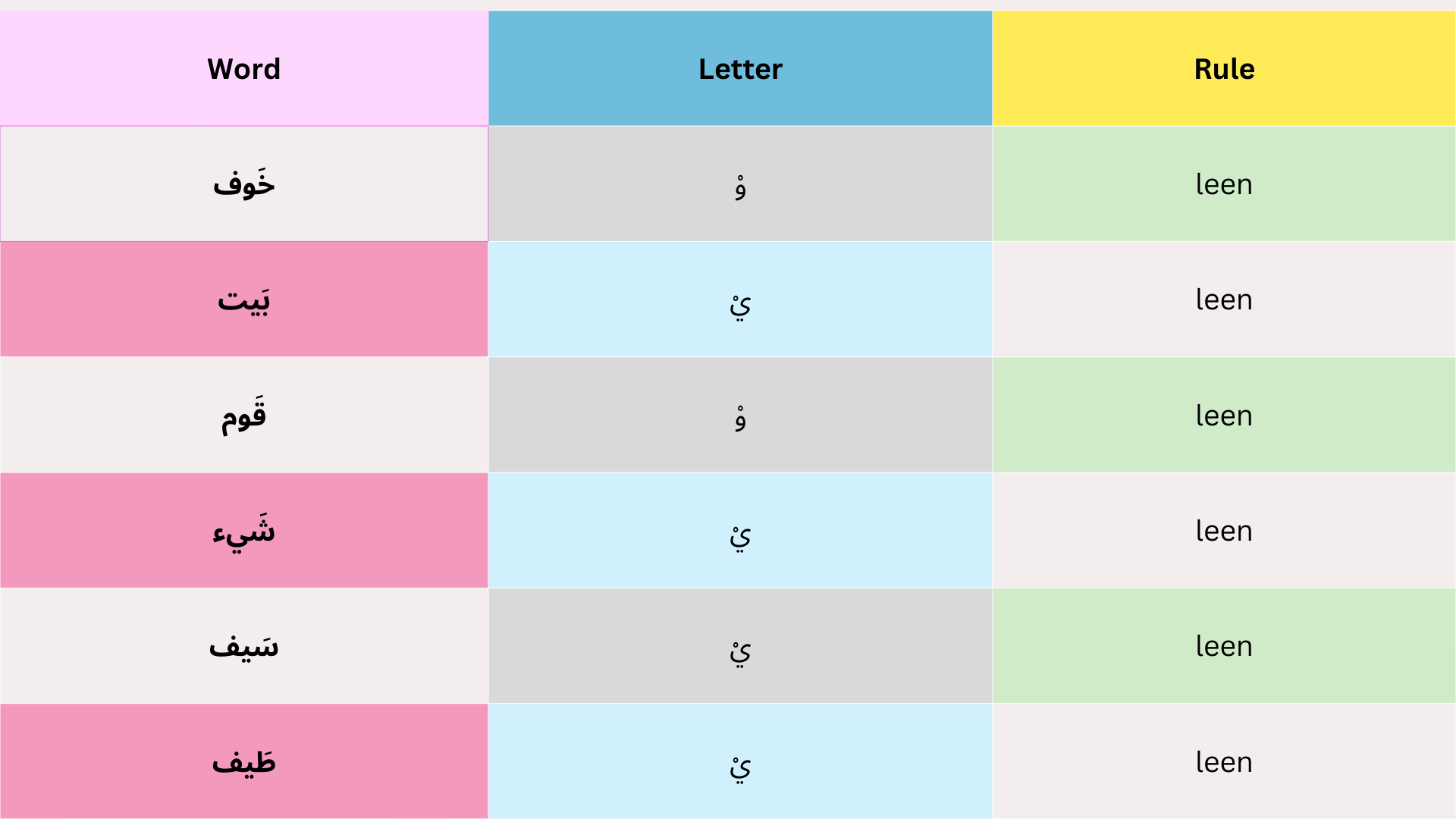
Leen Letters in Arabic for Non-Native Learners
If you're learning Arabic or the Qur’an as a non-native speaker, you might find the leen letters a bit challenging because:
- They aren't found in many other languages.
- English speakers might say they are too long.
- French speakers might round their lips too much.
- Asian speakers might add extra vowels.
Here's a simple way to remember:
- Leen means softness, not length.
- Madd leen means length when you stop speaking.r>Once you get this, everything else will feel much easier.
Teaching Leen Letters to Children
If you’re a parent or teacher helping kids learn tajweed, here’s a simple and practical approach.
Step 1: Teach the “Soft Glide” Concept
Tell children:
“Leen means soft — your voice slides like you’re going down a slide.”
Step 2: Use Movement
For “خَوف” → glide your hand forward smoothly
For “بَيت” → glide your hand in a small cu. rve
Kids remember the movement with the sound.
Step 3: Use Pairs
Have them read:
- خَوف ↔ خَوْز
- بَيت ↔ بَيْد
- قَول ↔ قَوْص
They begin to associate sound with pattern.
Step 4: Introduce Stopping Later
First, focus on reading in flow.
Then later explain:
“When we stop, the wind continues — that’s called madd leen.”
This helps them naturally distinguish leen letters from madd leen letters.
Leen Letters and Rhythm in Tajweed
Leen letters add a nice musical feel to the Qur’an. They help sounds connect smoothly, making the verses sound more joined together and pleasant to hear.
When you listen to a good reciter, you can hear how:
- The waw in خَوف flows smoothly.
- The ya in شَيء moves gently.
- The Madd Leen, when you pause, gives the recitation more emotion.
That's why learning leen letters properly in tajweed isn't just about getting the sounds right – it's also about creating a beautiful and meaningful recitation.
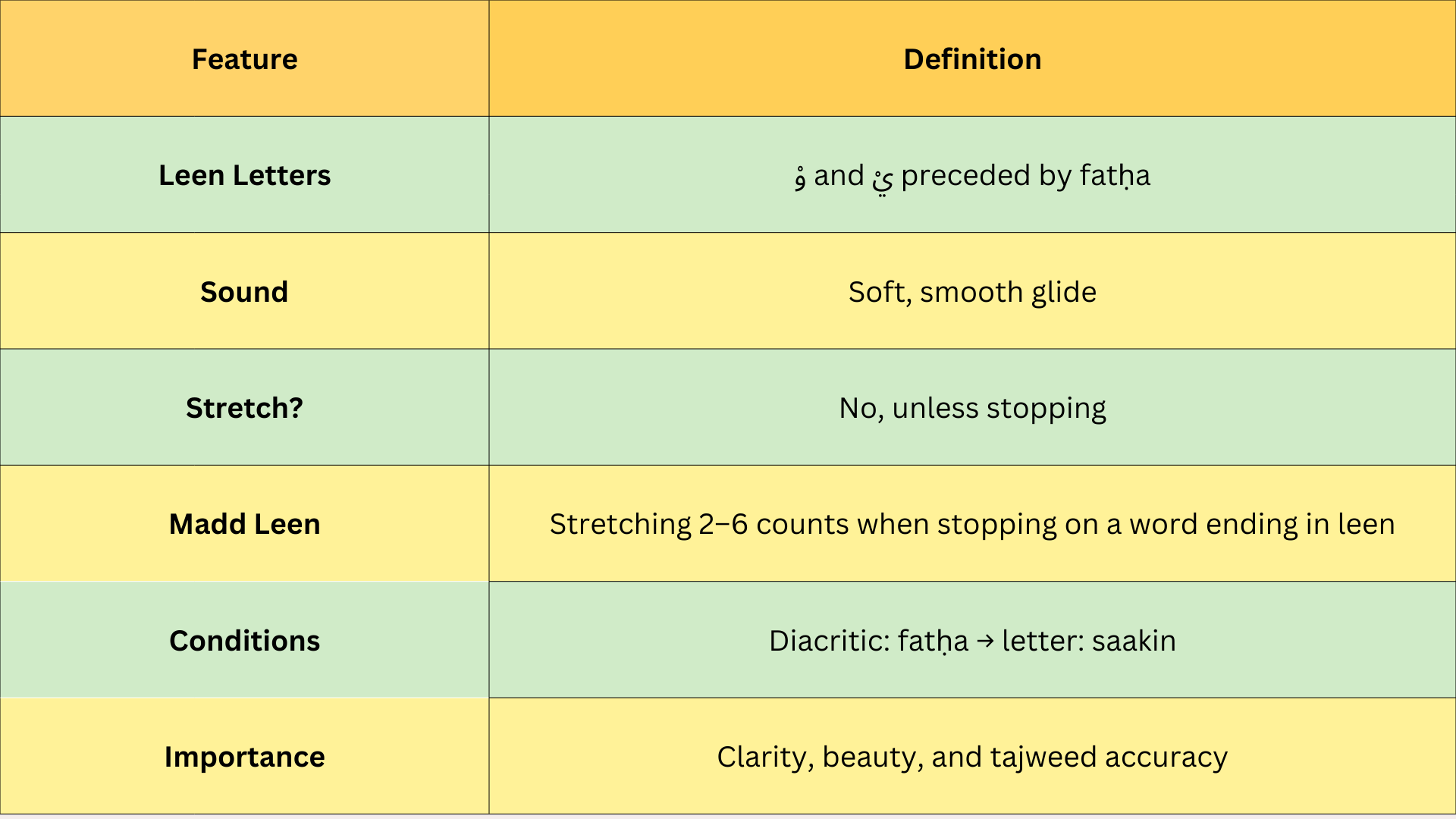
Summary Table of All Rules
Conclusion
Understanding leen letters in Arabic is important if you want to read the Qur’an smoothly and beautifully. The rules might seem complicated at first, but the idea is really simple.
There’s a soft sound in the middle of the letter, and a longer sound at the end.
Once you get used to this, your recitation will feel more natural, more confident, and more musical — just like it's meant to be. If you're practicing at home, don’t rush.
Speak slowly, let the words flow, and notice when your mouth feels relaxed. Those soft sounds are what make the Leen letters special.
With regular practice, the rules of leen letters will feel like second nature, and you’ll start to feel the beauty of madd leen letters every time you pause after a verse. This is only the start; your kids can learn so much more. Subscribe to Islamic Galaxy today!