
After downloading three apps, you discover: inappropriate ads, non-Islamic content, games teaching Egyptian dialect instead of Qur'anic Arabic, or worse — your child plays for weeks and learns nothing.
Not all Arabic learning games are equal. Some teach valuable skills. Others waste time. And some create bad habits that make Qur'an reading harder later.
As Muslim educators and parents as well, who've tested dozens of Arabic learning tools, we've identified what separates effective games from digital time-wasters.
Allah SWT revealed the Qur'an in the Arabic language
"إِنَّآ أَنزَلْنَـٰهُ قُرْءَٰنًا عَرَبِيًّا"
"Indeed, We have sent it down as an Arabic Qur'an" (Surah Yusuf, 12:2).
When teaching this sacred language with joy, not only do we make our children love it, but we also honor the Prophet's ﷺ gentle approach to education.
By the end of this guide, you'll know exactly what to look for, what to avoid, and how to evaluate any Arabic learning game for your child.
Why Arabic Learning Games Work for Kids
Arabic is difficult for English-speaking children. New alphabet. Right-to-left reading. Unfamiliar sounds. Traditional drilling can overwhelm, causing resistance. On the other hand, Arabic learning games can counter many of these points. Here’s how games change the game of learning:
- Repetition Without Boredom A child might refuse to write "ب" ten times on paper but happily click it 50 times in a game. Same learning, different experience.
- Immediate Feedback: When a child matches "مسجد" to a mosque and hears "Correct! That's masjid!" — the connection sticks.
- Screen Time with Purpose: Parents can feel good knowing 20 minutes of Arabic games beats random YouTube scrolling
- Low-Pressure Environment: Wrong answers in class can be embarrassing. In games? Just "try again!" — reducing anxiety, encouraging experimentation.
- Connects Arabic to Joy. The Prophet ﷺ said: "Make things easy and do not make them difficult, cheer the people up and do not repel them" (Sahih al-Bukhari 6125). Games embody this mercy in education.
But here’s the difficult part: games must be well-designed to deliver these benefits. Poorly made games waste time without teaching anything meaningful.
Ready to see which games work best? Let's break them down by type.
5 Types of Arabic Learning Games for Kids
A full education is not supposed to be the same for everyone. Different games teach different skills, and when you know what each type is, you can lead your kid through a spontaneous learning process to Qur'anic fluency.
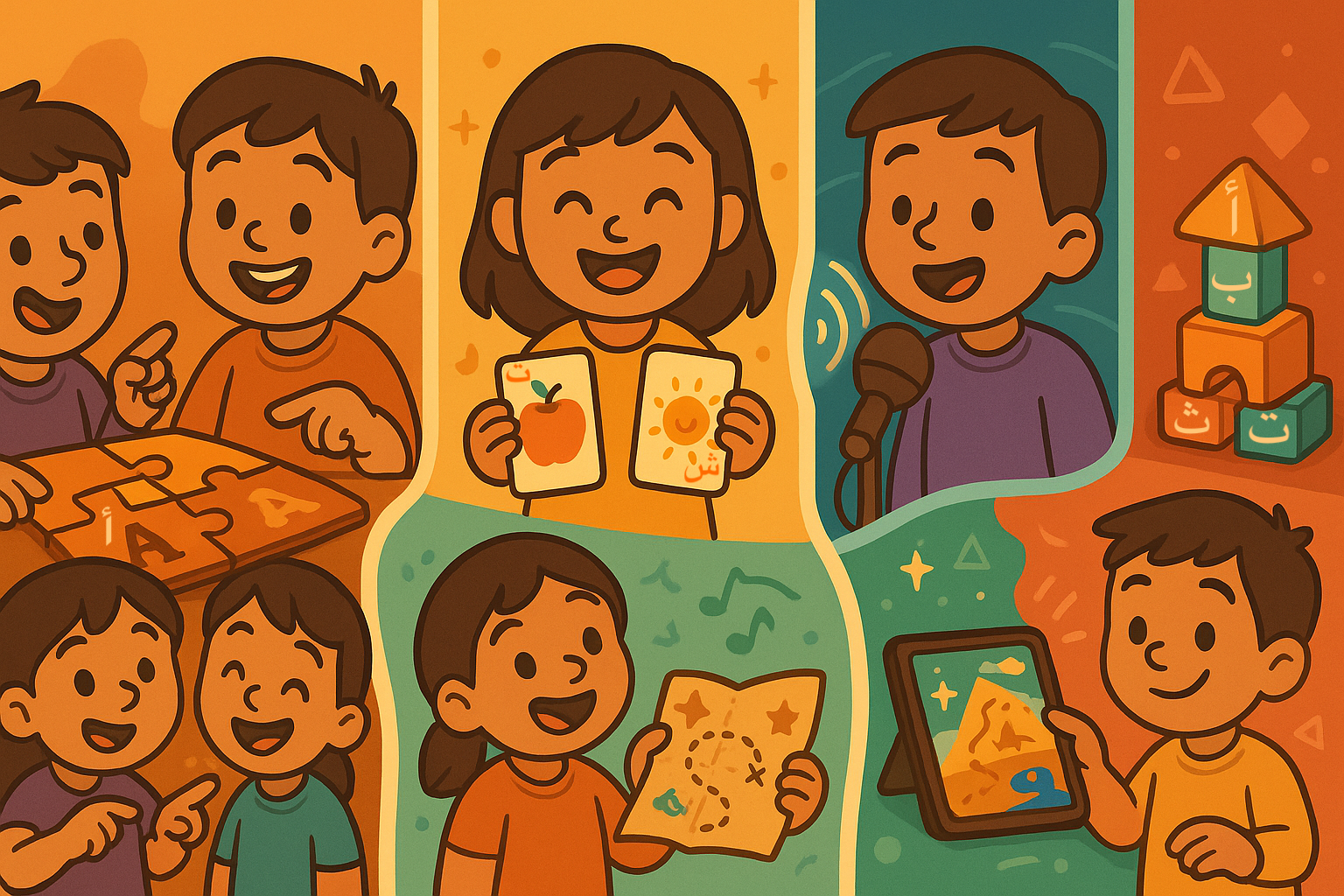
Type 1: Arabic Alphabet Games
What your child will master: All 28 letters from Alif to Ya
How these games work:
Consider these games as your kid's initial voyage to the Arabic globe. They will discover what the letter looks like, the sound of the letter, and the place of the letter in the words (first, middle, or last).
You'll see games like:
- Letter matching puzzles (drag the ا and connect it to "أسد", which means lion)
- Sound challenges (the game says "بَ" out loud, and your child clicks the right letter)
- Tracing activities (drawing letters with their finger on the screen)
Why kids don't get bored: Instead of drilling "write ب twenty times," the game makes each letter feel like a small victory. Your child isn't memorizing — they're discovering.
Best for: Ages 4-7
Type 2: Arabic Vocabulary Games
What your child will build: A treasure chest of everyday words plus Islamic vocabulary
How these games work:
Picture this: your child sees a cat on screen and has to match it to "قطة” or they're challenged to find all the animal words hidden in a group: أسد (lion), فيل (elephant), قطة (cat).
These games also use memory card formats with themed word sets — think colors, foods, family members.
Start with what they already hear:
The smartest vocabulary games begin with words your child encounters every single day:
- "ماء" (water) — they drink it
- "خبز" (bread) — they eat it
- "كتاب" (book) — they read it
Then add the Islamic words that matter:
- "صلاة" (prayer)
- "مسجد" (mosque)
- "دعاء" (supplication)
Level up to Qur'anic words:
Once your child feels confident, games introduce simple words they'll see when memorizing the Qur'an:
- "نور" (light) — they'll find this in Surah An-Nur (24:35)
- "رحمة" (mercy) — appears over 100 times in the Qur'an
- "شكر" (gratitude) — a concept they'll live with every day
Best for: Ages 5-10
Type 3: Speaking & Pronunciation Games
What your child will gain: The confidence to actually speak Arabic out loud
How these games work:
This is a typical scenario: many children are able to recognize Arabic words, but when they are asked to pronounce them, they become speechless. These games fix that.
Your child might:
- Record themselves saying "السلام عليكم" and get instant feedback on their pronunciation
- Order food at a virtual halal restaurant using Arabic phrases
- Practice tricky letter pairs (like ح and خ) until they can hear and speak the difference
The safe space factor: No one's watching. No pressure. Just your child, the game, and all the time they need to get it right.
One critical thing: The audio quality matters a lot. Make sure the game uses real native Arabic speakers — not robot voices. Kids copy what they hear, so the model needs to be perfect.
Best for: Ages 6-12
Type 4: Qur'anic Word Recognition Games
What your child will experience: Arabic stops being "foreign" and starts being "mine."
How these games work:
These games do something beautiful — they connect the Arabic your child is learning to the actual Qur'an they're memorizing.
They might:
- Go on a treasure hunt through Surah Al-Ikhlas, looking for the word "الله"
- Match words to meanings (رب = Lord, رحمن = The Most Merciful)
- Count how many times "قل" (say) shows up in the short surahs
Why this is a game-changer:
Just think about the fact that your kid was playing a matching game of "الحمد لله" with its meaning. Then a day later, during Salah, they listen to those very words in the Holy Quran, Surah Al-Fatiha — and it could not have been clearer.
The Qur'an isn't just sounds anymore. It's their language. Words they know. And that makes everything less scary, more meaningful.
Important design note: Good games treat Qur'anic text with respect. You'll see clear Uthmani script with proper diacritics, and the whole tone stays reverent — never casual or flippant.
Best for: Ages 7-14
Type 5: Arabic Grammar Games
What your child will understand: How Arabic sentences actually work
How these games work:
Grammar sounds intimidating, but these games make it feel like solving puzzles:
- Arranging word tiles to build correct sentences (subject + verb + object)
- Sorting words by singular vs. plural (تفاحة turns into تفاحات)
- Figuring out which words are masculine and which are feminine
The smart way to teach grammar:
Forget heavy terminology. Instead of "هذا is a demonstrative pronoun for masculine singular near objects," the game just shows:
"هذا كتاب" (this is a book)
"هذا قلم" (this is a pen)
Your child sees the pattern naturally. No memorizing definitions. Just recognition.
Why this helps with Qur'an: If your son or daughter grasps essential grammar concepts, then they will be able to keep track of the speaker in a verse, identify the object of the description, and figure out the relationships among the elements. To read the Qur'an is to comprehend, rather than just repeating.
Best for: Ages 9-14 (but if your 7-year-old is curious, go for it)
The Natural Learning Path (You Don't Need Everything at Once)
Here's how to build these game types into your child's journey without overwhelming them:
Ages 4-6: Foundation Stage
Stick with Types 1 & 2 (Alphabet + Basic Vocabulary)
Your goal: Letter recognition and about 50 common words
Ages 7-9: Connection Stage
Keep Types 1 & 2 going, but add Types 3 & 4 (Pronunciation + Qur'an Connection)
Your goal: Reading simple words and recognizing Qur'anic vocabulary
Ages 10-14: Mastery Stage
Bring in all five types, with extra focus on Types 4 & 5 (Qur'an + Grammar)
Your goal: Reading with real comprehension and understanding how sentences work
A Few Things Worth Remembering
Meet your child where they are: Don't stress about "should." If your motivated 8-year-old wants to try grammar games, let them. If your 10-year-old still needs vocabulary practice, that's perfectly fine. Every child moves at their own pace — honor it.
Games become more effective when they are combined: This is the wonderful mix - your kid is playing an alphabet game (Type 1), after that he utilizes those letters in a vocabulary game (Type 2), and then he locates those same words while doing a Qur'anic treasure hunt (Type 4). In fact, that is a very powerful learning that stays.
You're building something bigger: These aren't just games. They're building blocks toward your child having a real, personal relationship with the Arabic language — and through it, with the Qur'an.
Looking for a platform that brings all five game types together? IslamicGalaxy's growing library of Arabic games is designed specifically for Muslim children's Qur'anic journey — authentic content, halal design, built by people who understand what your family needs.
Offline vs Online Arabic Learning Games – Which Is Better?
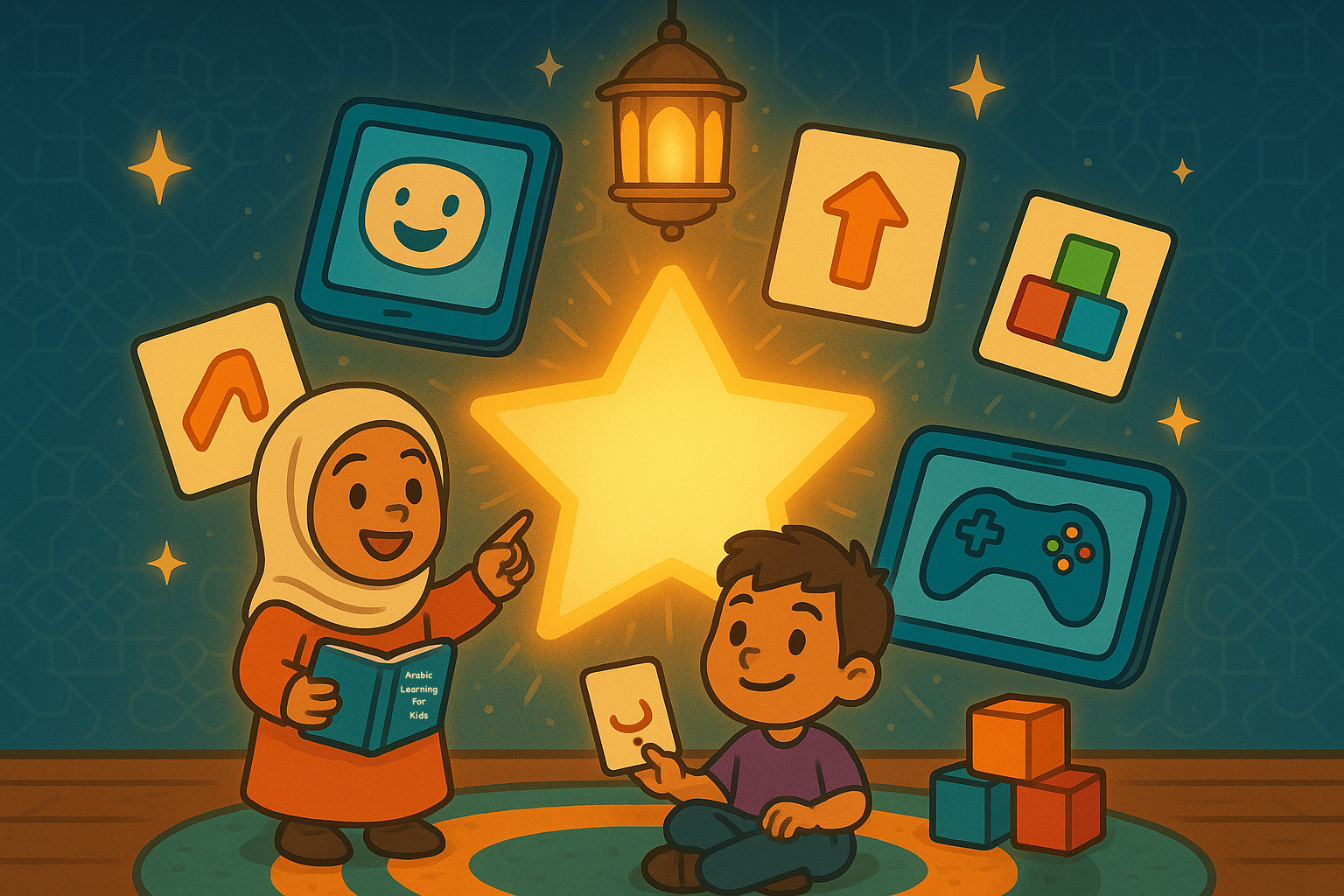
Honestly? You don't have to pick a side. Both work — just differently.
Offline Arabic learning Games for kids
Think flashcards, board games, Arabic puzzles, those letter magnets on your fridge.
What's great:
- Your kid actually touches and moves things (some children just learn better this way)
- Zero screen time: no blue light drama before bed
- You're doing it together: which means real bonding time
- Works anywhere: car rides, waiting rooms, grandma's house
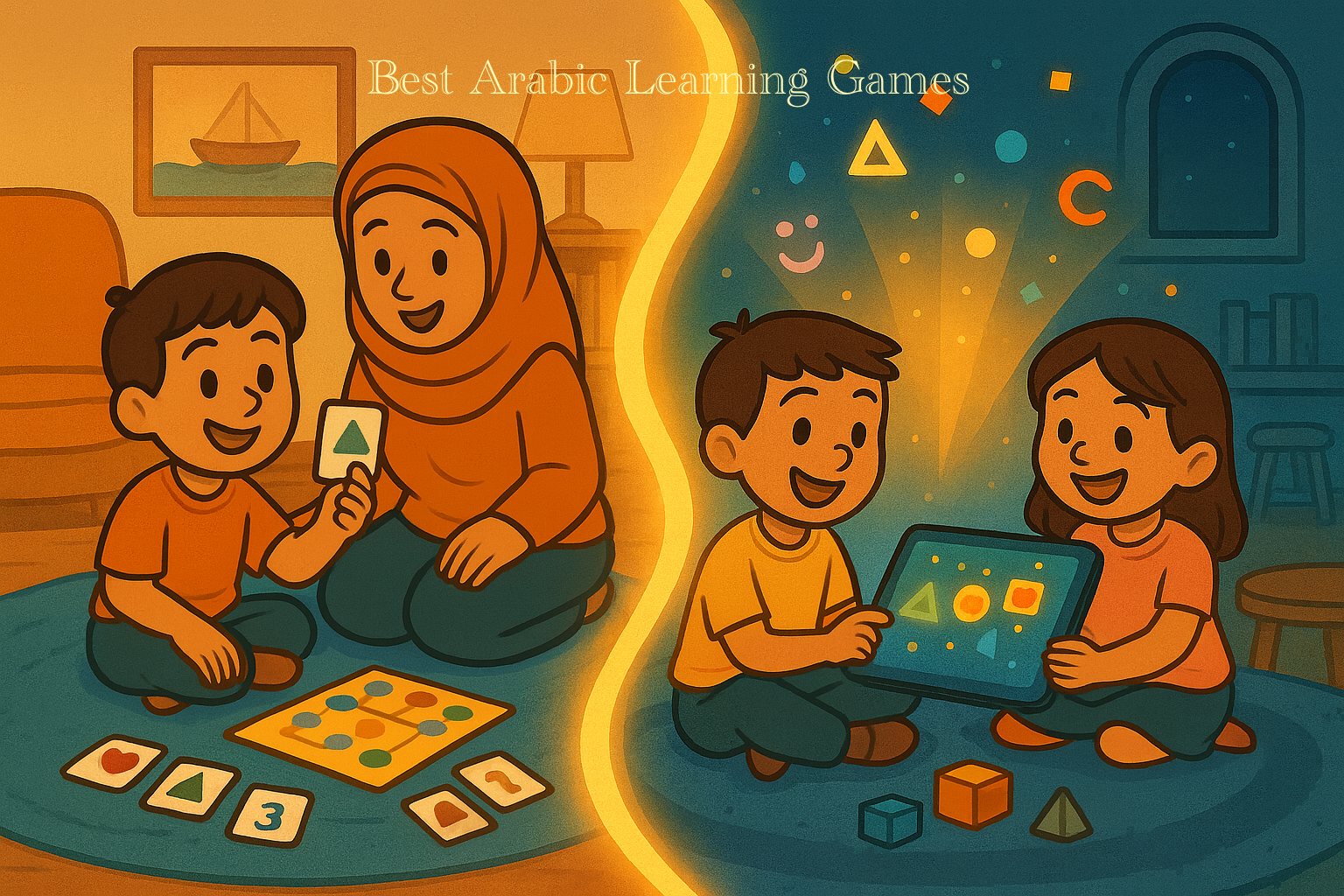
The catch: You need to be there. A 5-year-old can't really quiz themselves with flashcards. It's quality time, but it requires your time.
Offline Arabic learning Games for kids
Apps, websites, and tablet-based learning platforms like IslamicGalaxy.
What's great:
- The game adjusts to your child's level automatically
- Instant feedback — they know right away if they got it right
- You can see exactly what they've learned (parent dashboards are lifesavers)
- Your child can practice independently while you make dinner
- Native Arabic pronunciation every single time — even if you don't speak Arabic
The catch: It's still screen time. Educational, yes. But you'll want limits.
What Actually Works? Both.
Want to see learning really stick? Combine them. Your child plays an online game and learns "شجرة" (tree). Right after, you pull out the flashcard with that word. Then you both look out the window: "See that? That's a شجرة!"
Digital + physical + real world = learning that lasts.
Here's how smart parents do it:
Morning routine: 15 minutes of online games after Fajr (consistent, independent practice)
Evening ritual: Offline flashcards after Maghrib with the whole family — even the toddler who's just watching learns something
Busy moments: Online games when you're on that work call
Wind-down time: No screens an hour before bed? Perfect for Arabic puzzles
One mom told us, "Online games are his daily practice. Flashcards are our family time. My 4-year-old can't do the app yet, but she loves shouting out letters during flashcard games. Both matter."
The Screen Time Thing
Look, we get it. You worry about screens.
But here's the thing: 15 minutes learning Qur'anic vocabulary is not the same as 3 hours of random YouTube videos.
Set simple rules:
- Timer for online games (15-20 minutes max)
- One offline activity for every online session
- Switch to physical games an hour before bed
Educational screen time — when it's focused and limited — isn't the enemy. It's a tool.
IslamicGalaxy gives you online games you can actually feel good about — built by Muslim educators, safe content, and real progress tracking. The quality of offline learning, and the convenience of online.
5 Tips for Using Arabic Games at Home Successfully
1. Start with 10-15 Minutes Daily: Consistency Over Intensity. 15 minutes daily > 2 hours weekends. "After Fajr" or "before bed" makes it a habit.
2. Let Kids Choose Their Games Autonomy = engagement. "Do you want to play the letter race or the animal vocabulary game today?"
3. Celebrate Small Wins. Your child matched 5 Arabic words? That's a victory! Use sticker charts or special "Arabic game champion" treats.
4. Connect Games to Real Life. Played a food vocabulary game? Cook together and use those Arabic words: "Can you pass me the 'خبز' (bread)?"
5. Use Games as pre-Qur'an prep: Before memorizing a new surah, play games with keywords from that surah. It builds familiarity.
5 Fun Arabic Learning Games for Kids
1. Alif Ba Ta Adventure
Ages 4-6
Picture this: Your little one is helping a cute character walk through a glowing forest, and every few steps — ding! — They find a letter. First Alif, then Ba, then Ta. Each one makes a sound, does a little dance, and your kid giggles.
They don't know they're learning the alphabet. They think they're collecting treasures. And honestly? That's the whole point.
2. Qur'anic Word Match
Ages 6-8
Here's what happens: Your child sees the word "سميع" on screen. They have to match it to its meaning: The All-Hearing. Then "البصير" — The All-Seeing. One by one, they're meeting Allah's Beautiful Names.
Not in a heavy, serious way. Just... gently. Respectfully. The way you'd introduce a child to something precious. And later — maybe weeks later — you're reading Qur'an together and your kid points: "Mama, that's As-Sami! The one who hears everything!"
Yeah. That moment is everything.
3. Arabic Animal Safari
Ages 5-7
Your kid clicks on a lion. It roars. The game says "أسد."
Click the elephant. It trumpets. "فيل."
Giraffe? "زرافة."
Next thing you know, you're at the actual zoo, and your 6-year-old is pointing at animals saying their Arabic names while other families stare like "wait, how does your kid know that?"
(You can smile and just say "games" and leave it at that.)
4. Build-a-Du'a Game
Ages 7-10
This one's sneaky-powerful. Your child drags words around on screen to build the du'as they already say every day. "بسم الله" before eating. "الحمد لله" after. "السلام عليكم" when greeting.
They're not memorizing random phrases. They're learning what they've been saying their whole life. And suddenly — without you having to explain anything — it clicks. "Oh. That's what I've been saying."
Last week, a mom told us her son now says "بسم الله" before everything. Before homework. Before putting on shoes. Before brushing teeth. Because now he knows what it means.
5. Surah Treasure Hunt
Ages 8-12
Imagine your kid gets a mission: "Find the word 'رب' in Surah Al-Fatiha. How many times can you spot it?" They're scrolling through the Arabic text like a detective. Searching. Counting. Finding.
They don't realize they're becoming familiar with how the Qur'an looks. How it flows. Which words show up a lot? So, when is it time to actually memorize Al-Fatiha? They're not staring at foreign squiggles. They're seeing old friends.
One dad told us, "My daughter used to be scared of Qur'an class. Now she raises her hand because she recognizes words from the game. She feels confident."
That's the whole point of this.
All these games teach real Qur'anic Arabic. Not Egyptian slang. Not conversational dialect. The actual language of the Qur'an.
Because here's what happens if they learn dialect first: they get to Qur'an class, and nothing matches. Different words. Different grammar. Total confusion.
These games set them up to recognize the Qur'an from the very beginning.
Conclusion
Arabic doesn't have to be the subject your child avoids. With the right games, it becomes the activity they ask for—"Can I play the Arabic game now, Mama?"
When learning the language of the Qur'an feels like play, children build:
- Confidence to recite with understanding
- Connection to their faith
- Curiosity that lasts a lifetime
The Prophet ﷺ taught through gentleness and encouragement. Arabic learning games honor that spirit—making education a joy, not a burden.
Ready to transform Arabic learning in your home? Explore IslamicGalaxy's library of halal, interactive Arabic games. Start your free trial today—no credit card, no commitment. Just pure learning, pure fun.
FAQs
Q: At what age should kids start Arabic learning games?
A: As early as 4! Start with letter recognition games. By age 6-7, introduce vocabulary and simple Qur'anic words.
Q: Can games replace Arabic classes?
A: No — they're powerful supplements. Best approach: games (daily practice) + classes (structured learning) + real-world use.
Q: My child doesn't speak any Arabic. Games or tutor first?
A: Start with games! They're perfect for beginners: no pressure, unlimited repetition, self-paced. Once your child knows the alphabet and 20-30 words, a tutor becomes much more effective.
Q: How do I know if they're learning or just playing?
A: Test informally: Ask them to identify random letters, request ماء instead of water, and have them teach you one thing. Check the parent dashboard if available.
Q: Can games help with Qur'an memorization?
A: Yes, as a supplement. When kids know what words mean, hifdh becomes easier. Play vocabulary games before starting a new surah. But games don't replace learning Tajweed from a qualified teacher.
Q: Do dialect differences really matter?
A: Absolutely. Egyptian colloquial differs from Qur'anic Arabic. A child learning one won't recognize the other. Only use games labeled "Modern Standard" or "Classical Arabic."