
The chocolate bar was the big one. The family size one, with the purple wrapper. My niece Jana, seven, got it from her uncle and hid it in her school bag for three days so her little brother wouldn't find it. Three days. She checked on it every night like a dragon checking its gold.
On the fourth day the bar had melted into a sort of brown pancake because the bag had been sitting by the radiator. She cried. Her brother, who had no idea it even existed, asked what was wrong and then offered her half his apple.
I'm not saying it was a lesson from the universe. But it kind of was.
The open hand
The Prophet Muhammad, peace be upon him, was famous for this. Jabir said he was never asked for something and said no, and that's in Bukhari. People came to him with nothing and left with something, all the time.
There's also a hadith that the upper hand is better than the lower hand, in Bukhari as well. The giving hand is above the receiving one. I showed Jana with our hands, mine on top, hers underneath, then we swapped. She liked being on top. "So giving makes me higher?" In a way, yes.
Giving doesn't make you poorer
Kids, and a lot of adults, think sharing means you end up with less. Mathematically, sure, one chocolate bar split two ways is two halves.
But the Prophet said charity never decreases wealth. That's in Sahih Muslim. I don't explain the mechanics, honestly, I'm not sure anyone fully can. What I've noticed is that generous kids get treated generously back. Jana's brother with the apple, case in point. Friends share with friends who share.
And the Prophet said exchange gifts and you'll love one another. That one is in Adab al-Mufrad, and scholars grade it good. Giving builds love. Hoarding builds melted chocolate.
It doesn't have to be money
For a seven year old, generosity mostly looks small. Half a sandwich to the friend who forgot lunch. Letting the little brother go first on the swing, which for Jana is basically an act of heroism. Helping grandma hunt for her glasses for the fifth time this week.
Even a smile counts. The Prophet said smiling at your brother is charity, and that's in at-Tirmidhi. Jana tested this on the bus driver and reported back that he smiled too, "so I got paid."
Jana now keeps an "extra" snack in her bag on purpose. Not for her. For whoever forgets theirs. She says there's always someone.
Doing it as a family
Kids learn generosity by watching it. If they see you give to the man at the traffic light, pay for a neighbour's bread, send food when someone is sick, they absorb it.
Jana's family has a giving jar on the kitchen shelf. Every time someone gets money, Eid money, a birthday card, anything, a little bit goes in the jar first. At the end of the month the kids decide together where it goes. Last time they bought blankets for a cat shelter. Very serious discussion. Almost a vote.
Sharing games are good practice too, the kind where you have to pass things on or work as a team. A few of the Islamic Galaxy games work well for that with siblings.
When they won't share
Some kids, some days, just won't. And forcing a child to hand over their favourite toy usually backfires. They learn that sharing means losing.
Better to let them choose what to share, and praise it when they do. Some things can stay special and theirs. A child who feels secure about their own things shares more easily with the rest.
If your child asks where these sayings of the Prophet come from, our post on what a hadith is is a simple way to explain.
Conclusion
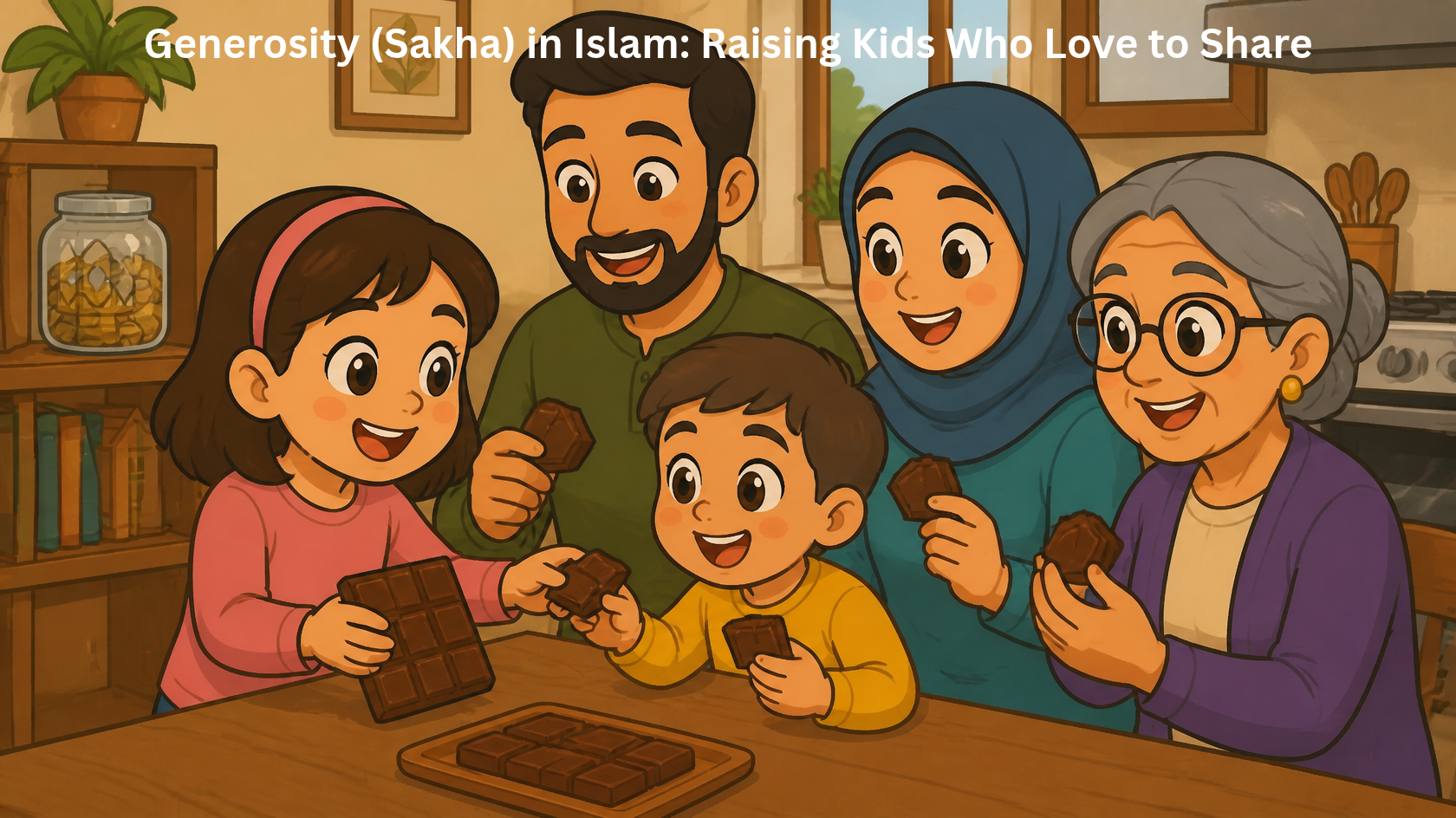
Jana got another big chocolate bar last week. Same purple wrapper. She opened it at the kitchen table, in front of everyone, snapped it into pieces and handed them round.
Mum, dad, brother, me, even the grandmother who's not supposed to have sugar. She kept the last two squares and ate them very slowly, grinning.
Nothing melted this time. For more videos, games and activities that help kids grow kind and generous, you'll find everything at Islamic Galaxy.
FAQs
What does Islam say about generosity?
Generosity, or sakha, is one of the most loved qualities in Islam. The Prophet rarely said no when asked, and he taught that the giving hand is better than the receiving one and that charity never makes your wealth smaller.
How do I teach my child to share?
Let them see you give, start a family giving jar, and let them choose what to share instead of forcing it. Praise them when they share. Telling stories of the Prophet's generosity helps them see giving as something good and joyful.
Does generosity only mean giving money?
Not at all. Sharing snacks, giving time, helping someone, letting a sibling go first and even smiling count. The Prophet said a smile at your brother is charity, so even little kids with no pocket money can be generous every day.