
There's a moment that happens in Muslim households constantly, so constantly it's almost invisible: something good happens, and someone says Alhamdulillah. Something bad happens, and someone says Alhamdulillah. Someone sneezes, someone finishes a meal, someone hears unexpectedly good news, someone gets through a hard week — Alhamdulillah.
A child watching this from the outside — or even a child who grew up inside it — could reasonably ask: why does this one phrase cover everything? What does it actually mean that it works for both the good and the hard? And why do Muslims say it so often that it becomes as automatic as breathing?
Those are good questions. They deserve a real answer.
What the Word Says
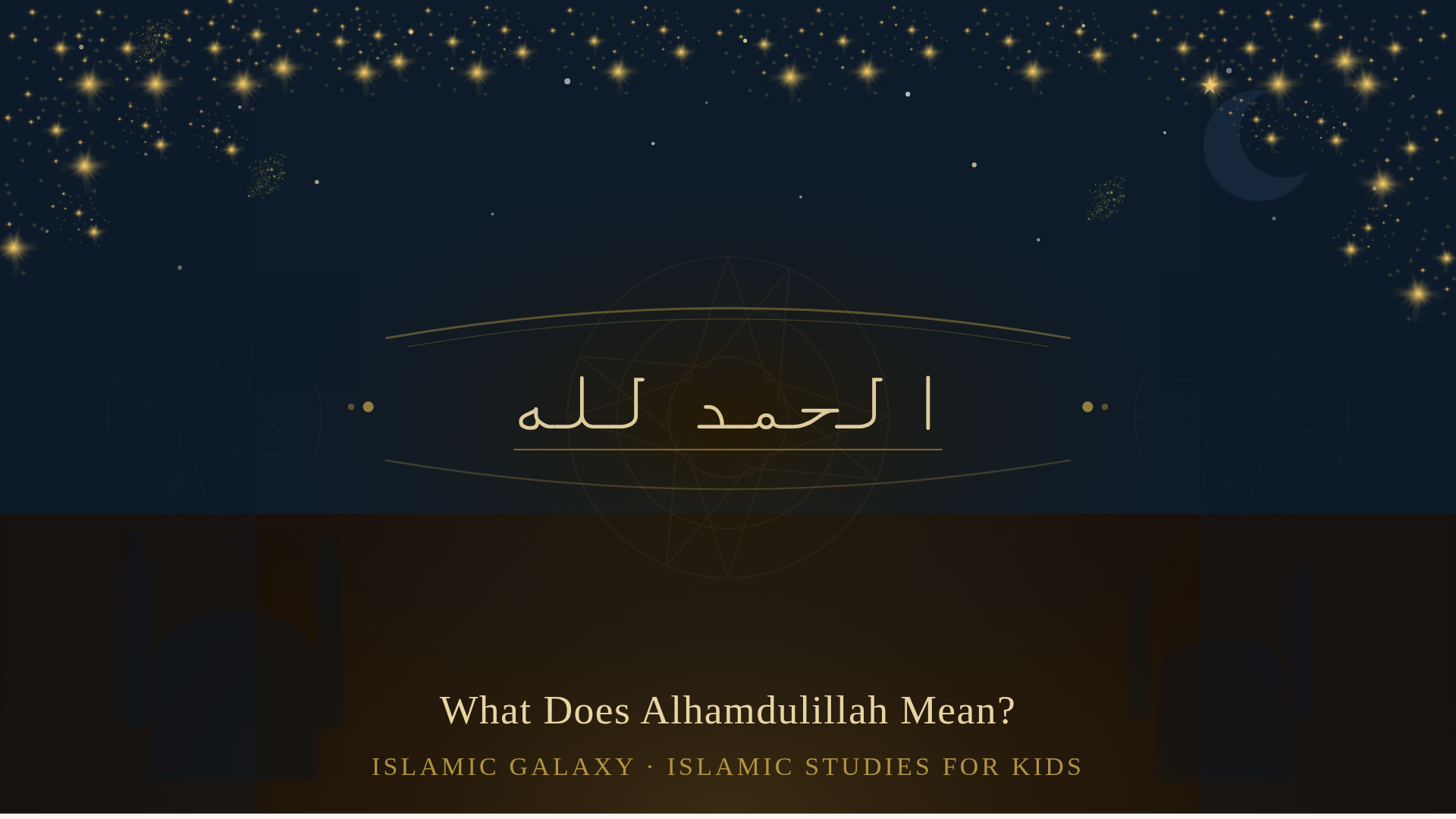
Alhamdulillah — الحمد لله — breaks down like this:
Al — the (the definite article, making it specific and complete) | Hamd — praise, gratitude, commendation | Lillah — belongs to Allah (li = for/to, Allah = Allah)
All praise belongs to Allah. Not some praise. Not most praise on good days. Al-hamd — the entirety of it, the definite, complete thing — belongs to Allah.
This is not casual. The word hamd in Arabic is different from shukr (شكر), which means gratitude or thanks. Shukr is something you give in response to a favor. Hamd is broader; it's praise that's given regardless of whether you personally benefited. You praise Allah not just because things went well for you, but because Allah is praiseworthy, full stop.
That's why it works for both good and hard moments. When things are good — Alhamdulillah, because this is a blessing. When things are hard — Alhamdulillah, because Allah is still praiseworthy even when your circumstances aren't comfortable.
The First Thing Muslims Recite
Alhamdulillah is literally the opening of Surah Al-Fatiha — the chapter Muslims recite in every single rakah of every single prayer, multiple times a day, every day of their lives.
"الْحَمْدُ لِلَّهِ رَبِّ الْعَالَمِينَ" — All praise is for Allah, Lord of all worlds.
Before anything else in the prayer — before asking for guidance, before the descriptions of Allah's mercy, before Ameen — there is this. Praise. Given first, not as payment for something received, but as the starting point of the whole conversation with Allah.
For anyone wanting to go deeper on this surah with their kids, this guide on what Surah Al-Fatiha is explains its meaning and significance in a way children can actually follow.
The Hadith That Changes How You Hear It
The Prophet ﷺ said: "Purity is half of faith. Alhamdulillah fills the scale. Subhanallah and Alhamdulillah together fill — or fill up — what is between the heavens and the earth." (Muslim)
Sit with that for a moment. Not that Alhamdulillah is a nice phrase. Not that it's a good habit. That it fills the scale. The mizan — the scale on which deeds are weighed — is filled by this.
He also said: "Allah is pleased with His servant who, when he eats food and praises Allah for it, or drinks a drink and praises Allah for it." (Muslim)
Praise after eating. That's it. That's the bar. The thing you do after every meal — Alhamdulillah — is something Allah is pleased with.
When Muslims Say It
The list is genuinely long, but here are the anchored moments:
After eating: "Alhamdulillah il-ladhee at'amanaa wa saqanaa wa ja'alanaa muslimeen" — Praise be to Allah who fed us and gave us drink and made us Muslims.
After sneezing: You say Alhamdulillah. The person next to you says Yarhamukallah (may Allah have mercy on you). You respond Yahdikumullah (may Allah guide you). A small exchange, completed in seconds, running through Muslim communities worldwide.
After prayer: Thirty-three times each — Subhanallah, Alhamdulillah, Allahu Akbar. Ninety-nine total. Then La ilaha illa Allah, wahdahu la sharika lah...
When something good happens: Immediate, reflexive, sincere.
When something hard happens: Also immediate. Also sincere — because the phrase isn't conditional on your circumstances being good.
It also appears woven into Bismillah, into the deeper meaning of Inshallah, into the fabric of how Arabic-speaking Muslims express thought. It punctuates sentences not as decoration but as a genuine reset — a return to awareness of where everything ultimately comes from.
What It Builds in Kids
Gratitude is one of the hardest things to teach children because it's invisible. You can teach a child to say 'thank you' — that's behavior modification. Actually feeling grateful, actually recognizing that things you have are gifts rather than defaults — that's a different thing.
Alhamdulillah, said consistently and sincerely, builds the second thing. Not just the words. The habit of noticing. The habit of pausing, even for a second, to register that food arrived, that you woke up, that the thing you were hoping for came through.
Research on gratitude — secular research, separate from the religious context entirely — consistently shows that people who actively practice gratitude have better mental health outcomes, better relationships, and greater resilience under stress. The Islamic practice of Alhamdulillah has been doing this work for fourteen centuries.
For parents thinking about how to build Islamic values into daily life with kids in a way that actually sticks, Islamic Galaxy's full library of Islamic content for children is worth exploring — there's a specific reason games and stories work better than lectures for this age group.
The Hard Version
The easy version of Alhamdulillah is the one said after good news. The hard version — the one that actually means something — is the one said when things are difficult.
The Prophet ﷺ said: "How wonderful is the affair of the believer, for his affairs are all good. If something good happens to him, he is thankful for it and that is good for him. If something bad happens to him, he bears it with patience and that is good for him." (Muslim)
Alhamdulillah in difficulty is not denial. It's not pretending things are fine. It's placing the difficulty inside a larger frame — one where Allah is still in charge, still praiseworthy, and where this hardship is not the final word on anything.
This is tawakkul in action. It connects directly to what tawakkul means for kids and families — trusting Allah even when the outcome isn't the one you wanted.
Explaining It to Kids Simply
Don't start with the theology. Start with the feeling.
'Alhamdulillah means all praise belongs to Allah. We say it when something good happens because Allah gave it to us. We say it when something hard happens because
we trust that Allah knows best. We say it so many times a day because there's always a reason — even in ordinary moments like finishing a meal or getting through a day.'
Then model it. Say it out loud, in front of them, in real moments — not as performance, but because you mean it. Kids learn this word the same way they learn love: by watching it done first.
Frequently Asked Questions
What does Alhamdulillah literally mean?
'All praise belongs to Allah.' It comes from three Arabic components: Al (the), hamd (praise/gratitude), lillah (belongs to Allah). The 'al' makes the praise complete and definite — not some praise, but the whole of it.
Why do Muslims say Alhamdulillah after sneezing?
The Prophet ﷺ instructed Muslims to say Alhamdulillah after sneezing. The person nearby then says Yarhamukallah (may Allah have mercy on you), and the response is Yahdikumullah (may Allah guide you). It's one of the specific Sunnah interactions that turns an ordinary physical reflex into a moment of connection and remembrance.
What's the difference between Alhamdulillah and shukr?
Shukr (شكر) is gratitude given in response to a favor received. Hamd is broader — praise given regardless of personal benefit. You can give hamd to someone for being praiseworthy even if they didn't do anything for you directly. This is why Alhamdulillah works in hard situations, not just good ones.
How many times a day do Muslims say Alhamdulillah?
At minimum, 33 times after each of the five daily prayers — 165 times from prayer alone. Add the after-meal dua, the sneeze response, and natural use throughout the day, and it's easily one of the most repeated phrases in a practicing Muslim's life.
Can non-Muslims say Alhamdulillah?
Linguistically, there's nothing stopping anyone from using the phrase. Many non-Muslims who grew up in Muslim-majority cultures or households use it naturally. The deeper meaning — that all praise genuinely belongs to Allah — is specifically Islamic in its theological weight.
Conclusion
A sneeze. A meal. A hard week. A thing you were hoping for, finally arriving. A thing you were hoping for, not arriving. Morning. The end of the day.
All of it lands in the same place: Alhamdulillah.
Not because the phrase is magic. Not because saying it changes the facts on the ground. But because it does something more subtle and more durable than that — it keeps the praiser oriented. Keeps them pointing in the right direction, even when the view from where they're standing isn't great.
Teach your kids this word properly. Not just when to say it — but why. The habit forms early. The meaning should form early too.