
You've heard it a hundred times. Maybe you say it yourself without really pausing to think about what you're actually saying. Someone asks if you're coming to dinner on Thursday, and before your brain has fully processed the question, your mouth has already answered: Inshallah.
Or you're a parent and your kid, somewhere around age six or seven, starts saying it too — picked it up from you, from grandparents, from the general air of the household — and one day they ask you what it actually means. And you realize you want to give them a better answer than 'it means maybe.'
It doesn't just mean maybe. That's the short version, and it's not even accurate. Here's the real one.
The Word Itself
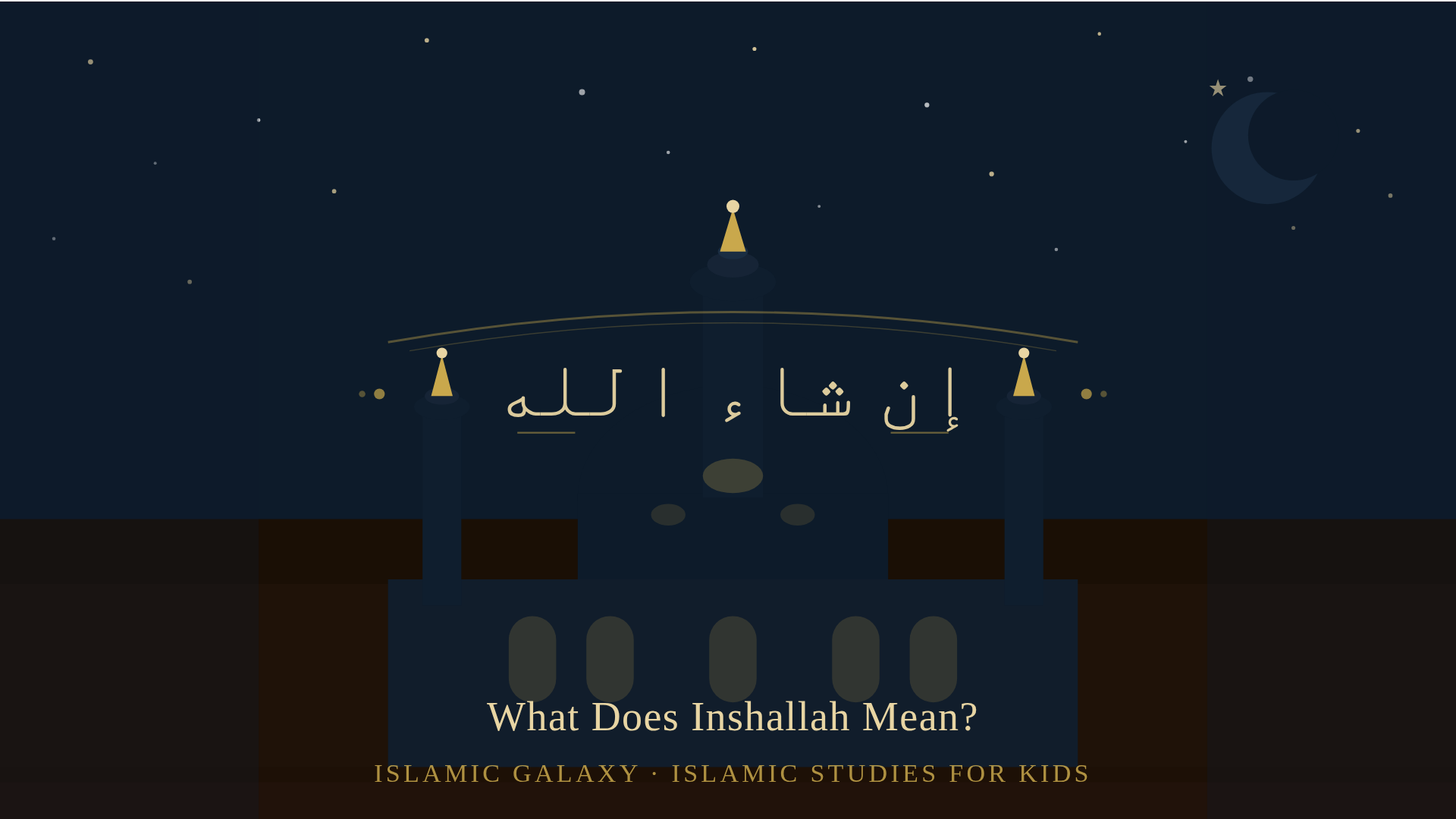
Inshallah — إن شاء الله — is three words joined into one phrase that rolls off the tongue so smoothly it's easy to forget it has parts.
إن — if. شاء — willed / wanted. الله — Allah.
If Allah wills. That's the translation. Not 'maybe.' Not 'probably not.' Not a polite way of saying no. The phrase is a genuine acknowledgment that what happens next — whatever it is — depends on more than your intentions.
You can plan. You can intend. You can fully mean it when you say you'll be at dinner Thursday. But whether Thursday actually comes the way you expect it to, whether you're healthy, whether the car starts, whether the world cooperates with your plan — that part isn't up to you. It was never up to you.
Inshallah is the honest version of 'yes.'
Where It Comes From
This isn't just a cultural phrase that stuck around. It comes directly from the Quran — Surah Al-Kahf, ayah 23 and 24:
"And never say of anything, 'I will do that tomorrow,' except [when adding], 'If Allah wills.' And remember your Lord when you forget." (Quran 18:23-24)
The context matters. These ayaat came down to the Prophet ﷺ as a reminder that even he — the Messenger of Allah — was not to speak about the future without this acknowledgment. Not because the future is unknowable in a frightening way, but because certainty about tomorrow belongs only to Allah.
So when you say Inshallah, you are not hedging. You are not being vague. You are placing your plans inside the correct frame — yours is the intention, Allah's is the outcome.
Why It's Not 'Maybe'
The joke version of Inshallah — the one that comes up in memes and comedy sketches — treats it as the Muslim equivalent of 'yeah, sure, whatever.' And to be honest, it sometimes gets used that way. A soft refusal dressed up as deference to the divine.
But this is a misuse, not the meaning. And it's worth being clear about that distinction, especially when you're trying to explain the word to kids who are going to grow up using it.
The Prophet ﷺ said: 'When one of you makes an oath and then sees that something else is better, let him do the better thing and make expiation for his oath.' That's the framework. You make plans. Life happens. You adjust. You don't hide behind religious language to avoid committing to things.
Real Inshallah is sincere. You mean the thing you're saying. And you genuinely acknowledge that its happening depends on Allah's will — not as a loophole, but as a truth.
Teaching It to Kids
Kids pick up Inshallah early — it's one of those words they hear constantly and start saying before they understand it. Which means there's a window, when they're curious about it, to give them the real meaning before the lazy version becomes the only version they know.
Start simple: 'Inshallah means if Allah allows it. We can plan and try our best, but whether something actually happens is up to Allah. So when we say Inshallah, we're being honest that we don't control everything — Allah does.'
Then show them where it's used correctly versus where it gets misused. If you say Inshallah and then don't try — that's not tawakkul, that's just avoidance. Real tawakkul means you do your part and trust Allah with the rest. This piece on what tawakkul means in Islam explains that concept in a way that pairs well with this one.
For younger kids, especially, connecting the phrase to something they can feel, like praying before a test and still studying hard, makes it concrete rather than abstract.
Islamic Galaxy has a full section of Islamic learning content for kids that helps build exactly this kind of foundational understanding in a way children actually enjoy.
The Other Times You Hear It
Inshallah doesn't just come up when making plans. It shows up in dua, in supplication — as an expression of hope that's placed correctly. 'Inshallah, I'll get better.' 'Inshallah, this works out.' Not fatalism. Not passivity. Hope with its feet on the ground.
It shows up in grief, too. When someone dies, when a diagnosis comes back hard, when the thing you were hoping for doesn't arrive — Muslims don't stop saying Inshallah. They say it about the future they're now facing. The word doesn't shrink when the circumstances get difficult. If anything, it becomes more necessary.
And it shows up in joy. 'Inshallah, you'll get into the school.' 'Inshallah, the baby is healthy.' Anticipation wrapped in trust.
Frequently Asked Questions
What does Inshallah literally mean?
It means 'if Allah wills.' The phrase comes from three Arabic words: إن (if), شاء (willed), الله (Allah). It's a sincere acknowledgment that future events depend on Allah's will, not just human intention.
How do you respond when someone says Inshallah to you?
You can respond with Inshallah yourself, or simply with a nod or acknowledgment. There's no required response. In many cultures, saying 'Inshallah' back signals shared understanding.
When should kids start saying Inshallah?
They'll naturally pick it up from the household. The important thing isn't delaying it — it's making sure they understand what they're saying before it becomes pure habit. A simple explanation around ages 5-7 is usually the right time.
Conclusion
Three words. A habit that runs so deep it comes out before conscious thought kicks in. And underneath it, a whole orientation toward life — one that takes both intention and surrender seriously at the same time.
You make the plan. You do the work. You say Inshallah. Not because you're not sure you'll try, but because you're sure enough about everything else to be honest about the one thing you don't control.
That's not passive. That's not vague. That's a grown-up relationship with reality, expressed in two seconds, that Muslims have been practicing for over fourteen hundred years.
Inshallah, your kids understand it the same way.