
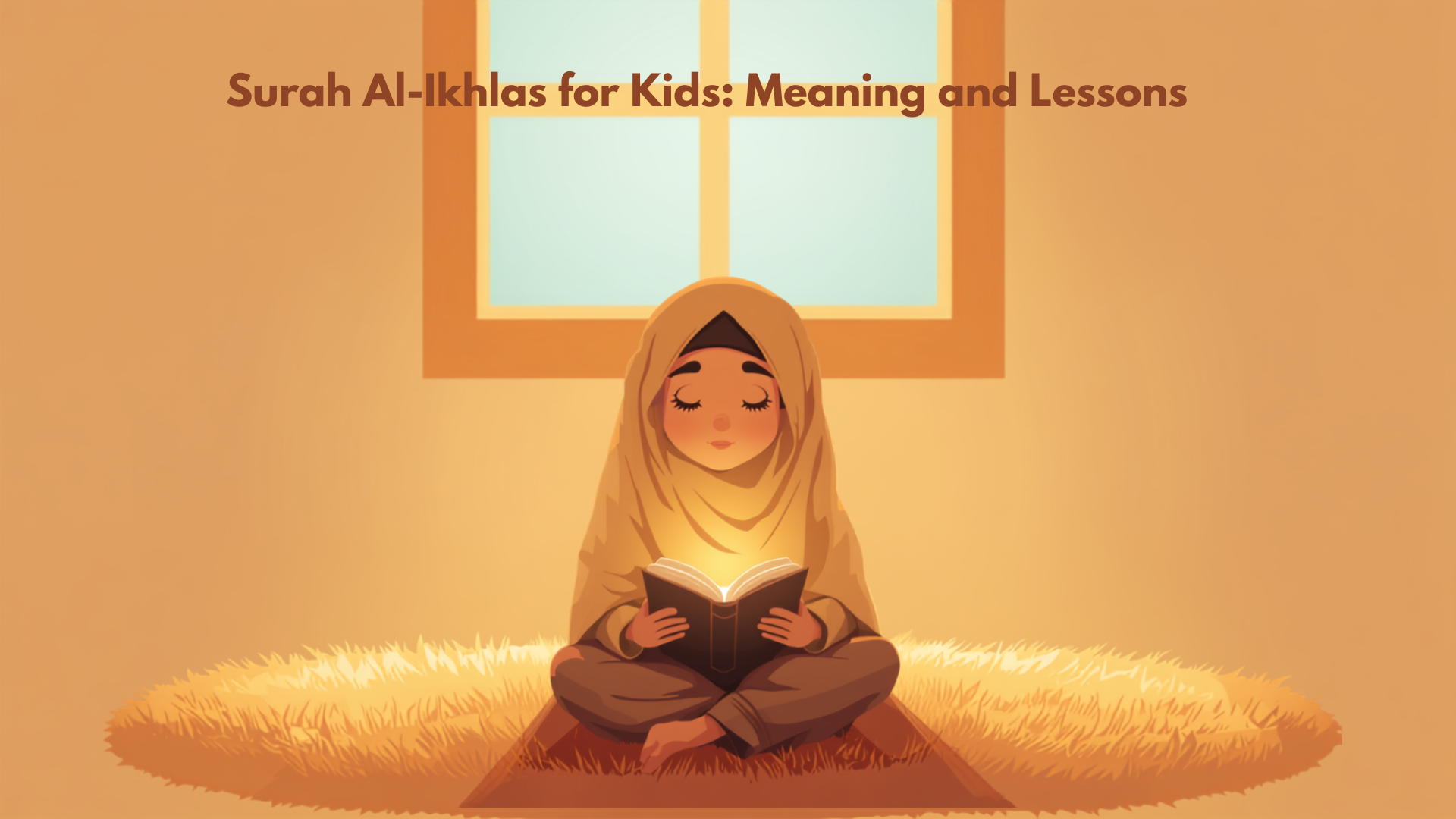
Surah Al-Ikhlas was one of the first ones my daughter memorized. She was four. It's short; that's basically the whole reason. Four-year-olds do not have patience for anything long, mine included. But then something happened I wasn't expecting: we actually broke down what it meant, not just the sounds, and she got it. Like, actually got it. That part still surprises me a little when I think back on it.
What It Actually Says
Four verses. That's the whole surah, four lines, the shortest chapters in the whole Quran probably. And yet. The Prophet said this one equals a third of the Quran in meaning. A third. For four lines. I remember hearing that as a kid myself and not really believing it, how could something so short carry that much weight? But it does, once you sit with what it's actually saying about who Allah is.
Here it is:
"Qul huwa Allahu ahad. Allahu s-samad. Lam yalid wa lam yulad. Wa lam yakun lahu kufuwan ahad." ("Say: He is Allah, the One. Allah, the Eternal Refuge. He neither begets nor is born, nor is there to Him any equivalent.")
Okay, So What Does That Mean for a Kid
Piece by piece, always piece by piece, dumping it all at once just glazes their eyes over. "He is Allah, the One" comes first. Biggest idea in Islam, honestly, packed into three words. One Allah. Not many. Kids get "the One" fast, faster than you'd think. Once you just say it plainly, there's only one; nothing else compares. Done.
"The Eternal Refuge" is trickier. I won't pretend it isn't. What worked for us, and this might not work for every kid, was framing it as, Allah's the one everyone depends on, but He doesn't depend on anyone at all. Ever. My daughter connected it to depending on us, her parents, and then I had to explain, well, we depend on Allah too, actually; everyone does, all the way up. That clicked eventually. Took a minute.
Last part. No children, no parents, nothing else like Him anywhere, not even close. This one's more theological, heavier, and honestly? Fine to keep it light for a young kid. You're not writing a thesis. Just planting the foundation; the rest comes later, over years, not one sitting at the dinner table.
Why It Gets Taught So Early
Short plus important equals early, basically. Right up there with Al-Fatiha as one of the first things kids memorize. Manageable length, serious content, good combination for teaching honestly.
If your kid's already deep into early memorization mode, this pairs nicely with the 99 Names of Allah. Same foundation really, who Allah is, just approached from a different direction each time.
Meaning Over Mechanics
Easy trap, focusing only on pronunciation. It matters, don't get me wrong. But a kid who knows what they're actually saying tends to think about it during prayer instead of just running through memorized sounds on autopilot. Big difference, even if it's not obvious at first glance.
She still recites this one fastest out of everything she knows. The difference now is she'll stop afterward, unprompted, and just tell you what it means. Nobody asks her
to. She just does it. That's really the whole point of any of this, if I'm honest. For more Quran-based learning made simple for kids, visit islamicgalaxy.
FAQs
Why is Surah Al-Ikhlas considered equal to a third of the Quran? It captures Allah's oneness and nature so completely despite being so short; the Prophet taught it holds the weight of a third of the entire Quran in meaning, not length.
What age can kids start memorizing Surah Al-Ikhlas? Most start around three or four since it's short and rhythmic enough to stick fast. Real understanding of the meaning usually develops gradually after that, not all at once.
Is Surah Al-Ikhlas recited in daily prayers? Yes, very commonly, often right alongside Al-Fatiha, making it one of the most repeated chapters in a practicing Muslim's daily life, prayer after prayer, year after year.