
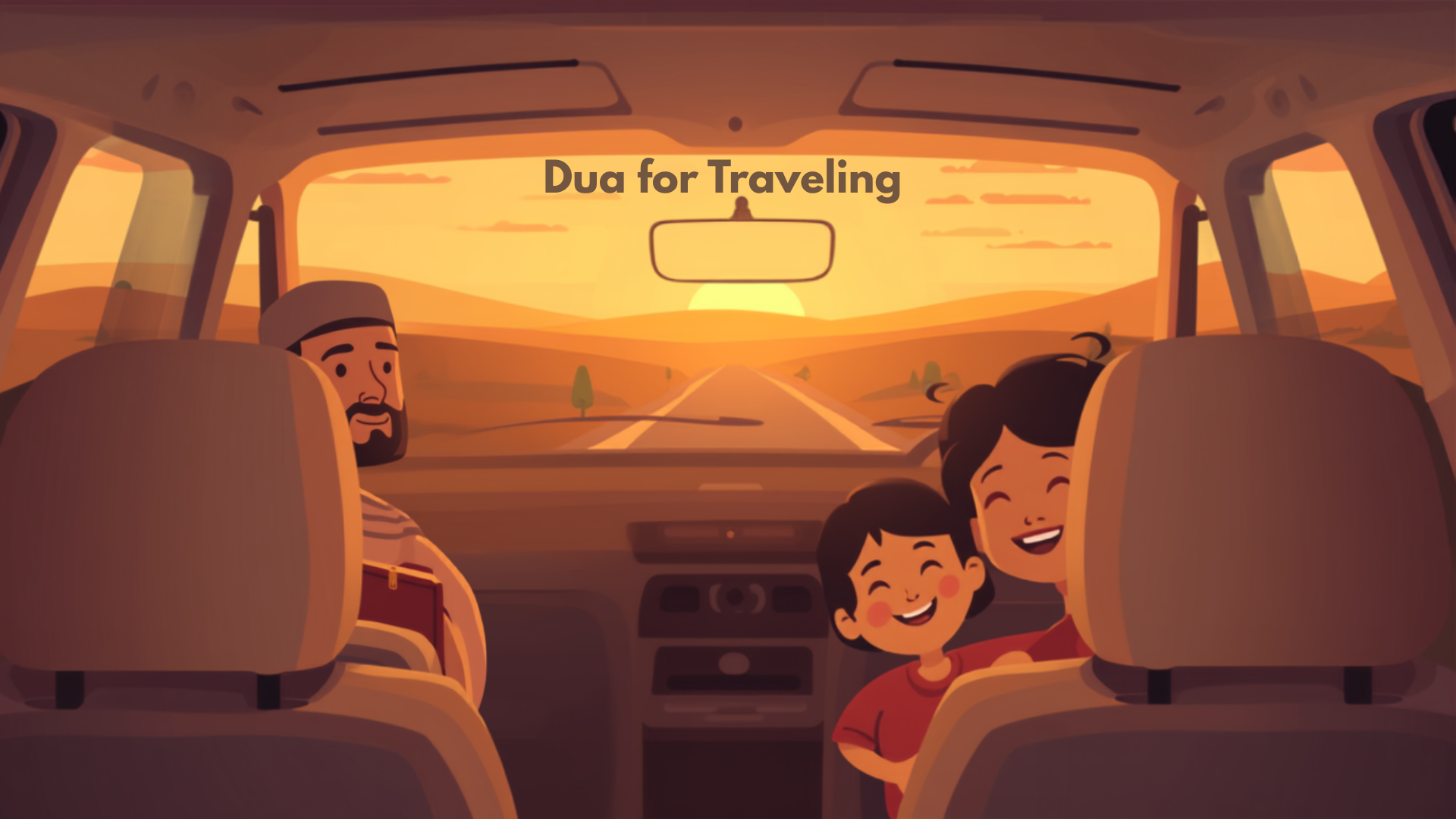
We drive two hours to my in-laws every few months, and for years that drive started with nothing more than buckling seatbelts and hoping nobody needed a bathroom break in the first twenty minutes. It wasn't until my son asked, completely out of nowhere, "Do we say a prayer for driving too?" that I realized we'd been skipping something worth doing this whole time.
The Dua the Prophet Taught
There's a specific dua the Prophet Muhammad, peace be upon him, taught for setting out on a journey. Long caravan trip across the desert, two-hour drive to grandma's, doesn't matter; distance really isn't the point here. What matters is the pause before you go. Acknowledging that arriving safely isn't something we fully control, no matter how routine the trip feels.
A commonly taught version goes:
"Subhanal-lathi sakhkhara lana hatha wa ma kunna lahu muqrineen, wa inna ila rabbina lamunqaliboon" ("Glory to Him who has subjected this to us, and we could never have accomplished this by ourselves. And indeed, to our Lord we will return.")
For a younger kid, shrink it way down. Something like, "Thank you, Allah, for this ride; please keep us safe on the way." That's plenty.
Why Bother With Something So Small
Kids notice patterns. Travel's one of those spots where a tiny ritual genuinely calms nerves, and not just spiritually, practically too. A kid used to a calm "let's say our travel dua" moment before the car even starts tends to settle into the trip faster than one who's just told to buckle up and be quiet already.
It teaches something bigger than travel safety too, honestly. A small, repeated reminder that we're not fully in control of outcomes, even the routine ones, even a drive we've made a hundred times without thinking twice. Useful things for a kid to slowly absorb. Not through a lecture. Through a habit, repeated enough times that it just becomes second nature eventually.
Making It Part of Every Trip
We say it now before pulling out of the driveway. Every single time. Doesn't matter if we're driving across town or across the country, same habit either way. For longer trips, flying to visit family, say, it slots in naturally right alongside other travel routines, right after the luggage gets loaded and right before whatever "takeoff" looks like for your family that day.
If you've already got a habit going of teaching kids to make dua for their parents, the travel dua fits right in next to it, especially on trips to see grandparents, where both duas end up feeling connected anyway, one leading into the other.
What If They Forget
Some trips we forget entirely. Especially the rushed ones, everyone's late, nobody's thinking about dua, we're just trying to find the car keys. That's fine, genuinely. The goal isn't a perfect streak. It's building enough familiarity that eventually your kid's the one reminding you from the backseat, which, honestly, is a pretty good problem to have.
These days my son says it almost automatically the second the car starts moving. Sometimes before I've even had the chance to say it myself. Small habit, but it's changed the whole tone of every drive we take together. For more everyday duas and gentle Islamic habits for your family, visit islamicgalaxy.
FAQs
Is the travel dua only for long trips? No, it works for any journey, short or long. The point isn't distance; it's the habit of pausing to acknowledge Allah's protection before setting out, even for a quick errand.
Can I say the dua in English instead of Arabic? Yes, especially with younger kids. Understanding the meaning matters most at first, and the Arabic version can be introduced gradually as they grow more comfortable with it.
What if we're already halfway through a trip and forgot to say it? It's never too late. Saying it partway through still counts as a meaningful moment of gratitude and trust, even if the timing isn't exactly as taught.