

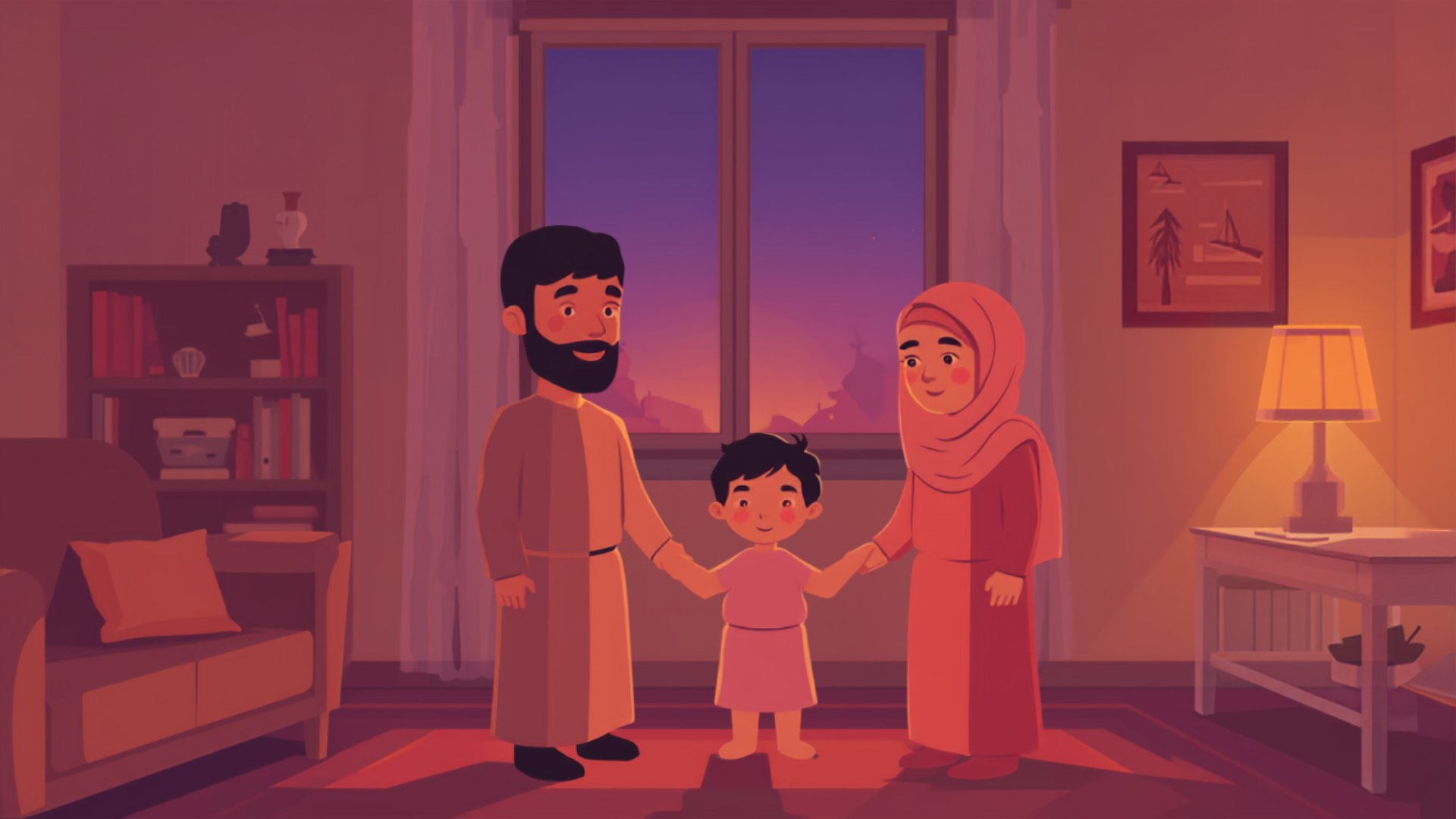
My son asked me something once, totally out of nowhere, while I was folding laundry of all things. "Do I have to pray for you when you're not even sick?" It threw me off a little, but it turned into a pretty good conversation, because dua for parents was never really about emergencies in the first place. It's about gratitude, and honestly that's a habit worth planting long before anyone's actually worried about anything.
The Dua From the Quran
There's a specific dua for parents right in the Quran, Surah Al-Isra, 17:24, where Allah teaches us to say:
"Rabbi irhamhuma kama rabbayani sagheera" ("My Lord, have mercy upon them as they raised me when I was small.")
What gets me about this one every time is what it's actually acknowledging — that our parents chose to take care of us long before we could give anything back, and Allah is asking us to notice that, out loud, not just feel vaguely thankful about it somewhere in the back of our minds. Teaching this to a kid early plants something that only grows stronger as they get older and start to actually understand how much their parents have been doing this whole time.
How to Teach It So It Actually Sticks
I found it worked best to explain the meaning before ever asking my son to memorize the Arabic. Something like, "this is a special prayer where we thank Allah for Mama and Baba, and ask Him to take care of them, the same way they've always taken care of us." Then I'd ask what one thing they did for him that day, and connect it right back — this dua is basically saying thank you to Allah for that exact thing.
It helps to just tack it onto something you're already doing. It slides in naturally at the end of a bedtime routine, or right after the morning dua — attaching something new to a habit that already exists just makes the whole thing stick faster, at least it did for us.
I'd also say let kids use actual names when they make this dua, not just a generic "my parents." Kids connect with specific things way more than vague ones. And if your own parents are still around, let your children hear you make this dua for them too — it teaches by example better than any explanation could. If they've passed, this becomes something else entirely, a gentle way to introduce the idea of praying for people who are no longer here.
A Habit That Deepens With Age
What starts as a memorized line when they're small turns into something a lot deeper later on. I've heard from other parents whose teenagers, having made this dua for years without really thinking hard about it, describe genuinely feeling more grateful toward their parents — not because anyone forced the feeling, just because years of quiet repetition did something underneath the surface.
Worth teaching alongside Dua e Hajat, the prayer of need, too, so kids get it early — dua isn't only for asking Allah for stuff. It's also just for saying thank you, out loud, for the people Allah put in your life.
Conclusion
I still think about that laundry-folding moment sometimes. My son didn't really get it that day. He gets it a lot better now. Which is kind of the whole point of teaching dua young — it's less about instant understanding, more about planting something that keeps quietly growing. For more duas, stories, and faith-building content made with families like yours in mind, take a look at islamicgalaxy.com.
FAQs
At what age can a child start making dua for their parents? As soon as they can repeat simple phrases, usually around three or four, even if they don't fully grasp the meaning yet.
Can this dua be made for parents who have passed away? Yes, and it's actually one of the most common duas made for deceased parents specifically, since it directly asks Allah for mercy on their behalf.
Should kids say this dua in Arabic or in their own language? Either works. Understanding the meaning is what matters most, and the Arabic can be added in gradually as they grow more comfortable with it.
Is this dua only for biological parents? While it specifically references parents, many families extend a similar spirit of dua to grandparents or guardians who raised them.