
If you've been helping your child learn Qur'an, you've probably seen a small symbol that looks like a tiny 'w' sitting on top of certain letters. What you see there is a shaddah ( ّ ), and once your kid gets familiar with the Shaddah rules, he or she will be able to recite nicely and more correctly. Don't worry, it's much easier than it looks, and we'll break it down together step by step.
What Is Shaddah in Arabic?
You know that tiny "w" shape you sometimes see sitting on top of Arabic letters when you're reading the Qur'an with your kids? That's called a shaddah ( ّ ).
I remember when I first started helping my own child with Qur'an, I'd skip right over it, thinking, "Oh, it's just a decoration or something." But turns out, it's actually super important!
Here's the easy version: if a letter carries a shaddah, you extend the sound of the letter only by a very small amount. Say you were playing piano and you pressed a key twice very quickly, not two separate presses but one continuous press that lasts one beat longer. That's shaddah.
The letter basically gets said twice. First time without any vowel sound, second time with the vowel. So it sounds like you're gently emphasizing it. My daughter's teacher once told her to imagine saying "uh-oh" — notice how your throat does that little double thing with the 'h'? That's kind of how shaddah works, just with different letters.
When you understand what to listen for, you can hear it in every Qur'an recitation. And to be honest, that really enhances the beauty and clarity of the words.
How Shaddah Changes the Sound?
Alright, so why should we even care about this little mark? Well, because it can completely change how a word sounds — and sometimes what it means too.
The easiest example? The Prophet's name ﷺ: مُحَمَّد (Muhammad). See that shaddah on the مّ? That's what makes it sound like "Mu-ham-mad" instead of "Ma-ha-mad."
Here, look at the difference:
| Without Shaddah | With Shaddah |
| مَحَمَد (Ma-ha-mad) | مُحَمَّد (Mu-ham-mad) |
Big difference, right? Without that shaddah, it's not even the same name anymore.
That is the reason that we, parents, when kids are learning to recite, gently remind them to catch those shaddah sounds. It is not about being perfect right away. Believe me, my son still misses them sometimes, and he has been learning for two years! But the more they expose themselves to good reciters and slow practice, the more their ears get accustomed to it without effort.
And honestly? Getting the shaddah right is part of what makes Qur'an sound the way it's supposed to sound. It's preserving the exact words that were revealed.
By the way, if you're looking for a structured way to help your child really nail these Tajweed basics, Quran Galaxy has some really good courses. They break down shaddah and other rules with audio examples and fun practice exercises that actually keep kids interested. Worth checking out if you want something more hands-on than YouTube videos.
So now that we've covered what shaddah is and how it affects pronunciation, let's talk about why it matters so much when your child is reciting Qur'an…
Why Shaddah Matters in Qur'an Recitation?
That little dot above a letter is probably the furthest thing from your mind when you are sitting with your child, trying to finish just one page of Qur'an without them constantly moving or asking for snacks. I know how that feels. I've been there. But here's why shaddah is actually worth paying attention to:
1. Clarity: It just makes words sound clearer. When kids skip the shaddah, everything sounds rushed and blurry. With it, each word has its own space, and you can actually tell them apart.
2. Meaning: This is the big one. Sometimes, missing a shaddah changes the entire word into something else. Take إِيَّاكَ (Iyyaka) from Surah Al-Fatiha. That shaddah on the يّ is what makes it mean "You alone" with that strong emphasis. Without the shaddah, it becomes إِيَاكَ (Iyaka), which sounds similar but loses that emphasis completely. And we're talking about Allah's words here, so getting them right really matters.
3. Tajweed accuracy. You know how scholars like Imam al-Jazari wrote down all these Tajweed rules centuries ago? Shaddah has always been part of that. It's how the Qur'an has been recited correctly, generation after generation. Teaching our kids to do it right connects them to that whole tradition.
4. Beauty. Honestly, Qur'an just sounds better when the shaddah is there. It has this nice rhythm and flow. When my daughter finally nailed it in Surah Al-Ikhlas, I made her repeat it because it sounded so good. That's the difference shaddah makes.
Now listen, if your child isn't getting this yet, don't panic. My nephew still races through his surahs and skips half the shaddah marks. It's normal. Children require a certain amount of time and a heap of listening practice before their ears can distinguish it. He remembers it some weeks and forgets it other weeks. That's exactly how learning operates. Keep it light, keep practicing, and eventually it clicks.
If you want some extra help teaching this stuff, check out our Islamic Galaxy with its Audio examples, practice activities, and the whole thing. Way better than me trying to explain it after a long day. Just something to consider if you feel stuck.
So that's why shaddah matters. Let us move from place to the rules of the Shaddah. In reality, just four of them exist, and they are quite straightforward when used.
Basic Shaddah Rules in Tajweed (Explained for Parents)
Alright, so now you know what shaddah is and why we care about it. Let's get into the actual rules. I promise this won't get complicated. Just a few simple things that'll help you and your kid get it right.
1. Shaddah Always Doubles the Letter
So here's the deal. When you see a shaddah sitting on a letter, that letter gets said twice. Like two quick beats.
Their way of doing it is: you first pronounce the letter without any vowel (more or less silent), and then, without any break, you say it again with the vowel. So مَّ sounds like "mm-ma." That first "mm" is quick and silent, then "ma" comes right after with the vowel sound.
I heard a teacher explain it to a group of kids once using a basketball. You bounce it twice really fast: bam-bam. Not "bam...pause...bam." Just bam-bam in one smooth motion. That's shaddah. My son actually got it after that example when nothing else worked. Once kids understand this, the rest is honestly just practice and listening.
2. It Always Contains a Hidden Sukoon + Vowel
Alright, it may sound a bit nerdy, but it actually is logical when you understand it.
Each shaddah encloses a hidden sukoon (the little circle that indicates the stop of a vowel) and a vowel mark. Therefore, when you consider رَبِّ (Rabbi), the deepest level it means: the first ب is the one that has a sukoon stopping it, then immediately the second ب is given the kasra vowel.
Basically, it's like رَبْبِ but squished into one symbol: رَبِّ.
You don't need to teach this to little kids. But if you've got an older child or a curious teenager asking "but WHY does it sound like that," this is the answer. It helps them understand the stop-then-start feeling of the doubled letter.
Bottom line: sukoon stops it, vowel starts it back up, and shaddah is just both things combined.
3. Shaddah Stretches the Letter Slightly
Here's where parents sometimes get mixed up. Yes, shaddah makes the letter a little longer, but it's not a big stretch like those madd rules where you hold it for ages.
It's just a gentle hold. And the sound has to stay smooth. No gaps, no breathing in the middle, no stopping and restarting.
So if your kid says "Rab...bi" with a pause, that's wrong. It should be "Rab-bi" in one go, just with a little extra emphasis on that "b."
Here's how I explain it: you know when something falls, and you say "uh-oh"? Feel how your throat kind of doubles up on that sound? That's the vibe. One smooth sound, but with a little bounce in the middle.
No breath. No stop. Just a smooth stretch.
Quick tip: Start slow. Let your kid hear you doing it slowly and a bit exaggerated at first. Then speed it up to normal. Kids pick things up way better when they can hear it clearly first.
4. Shaddah Can Appear on Any Letter (Except Alif)
Quick note: shaddah can show up on basically any Arabic letter. ب، ت، ن، م، ل، whatever.
Except one. Alif (ا) never gets a shaddah. Never.
Why? Honestly, without turning this into a grammar lecture, Alif just works differently. It's a vowel letter and doesn't double like the others. It stretches sounds but can't have a shaddah on it.
So if your kid points to an alif and asks, "Can this have shaddah?" the answer is nope, that's the one letter that can't.
Easy enough.
Shaddah vs No Shaddah: What Actually Changes
Let me show you some real examples so you can see how much of a difference this tiny mark makes. These are words you'll hear all the time in the Qur'an.
| Word | With Shaddah | Without Shaddah | What Changes |
| رَبّ | Rabb (Lord) | Rab (nurtured) | Totally different word |
| إِيَّاكَ | Iyyaka (You alone) | Iyaka (weaker sound) | Loses its strength |
| الصَّمَد | As-Samad (The Eternal) | As-Samad (sounds off) | Sounds wrong and unclear |
See that? It's not just "oh, it sounds a bit nicer with shaddah." The actual meaning changes when you skip it. That's why teachers keep reminding kids about it.
Try this: pick one of these words and say it both ways out loud with your child. Let them really hear the difference. That moment when they go "ohhh I hear it now" is golden.
Alright, now that you've got the basic rules, let's talk about how to actually teach your kid to read and pronounce these correctly…
How to Read the Shaddah (The "Double Sound" Technique)
Okay, so your kid understands what shaddah is. Now, how do you actually read it? Let me break this down into three super simple steps.
Step 1: The First Letter Is Silent (Sukoon)
The first part of reading shaddah is understanding that the letter gets said once without any vowel sound. It's like a quick stop.
Think of it as the letter having a hidden sukoon on it. So if you're looking at رَبِّ (Rabbi), that first ب is read like بْ (just "b" with no vowel after it). You're basically stopping the sound right there.
So for مَّ, you'd start with "mm" (no vowel). For نَّ, you'd start with "nn" (no vowel). Just the letter by itself stopped.
That's step one. Hold that thought.
Step 2: The Second Letter Has the Vowel
Now, right after that stopped sound, you immediately say the letter again, but this time with the vowel mark that's shown.
So, going back to رَبِّ: after that stopped بْ, you now say بِ (bi) with the kasra underneath. Put them together, and you get: "b...bi" which sounds like "bbi."
- For مَّ: first "mm" (silent), then "ma" (with the fatha). Together: "mm-ma."
- For نَّ: first "nn" (silent), then "na" (with the fatha). Together: "nn-na."
The key here is that the vowel only comes on the second pronunciation of the letter. The first one stays quiet. Kids get this pretty fast once they try it a few times out loud.
Step 3: Combine Them Smoothly
Alright, here's where it all comes together. You don't want it to sound choppy like "b...bi" with a weird gap. It needs to flow as one smooth sound.
So instead of: "Rab...pause...bi."
It should be: "Rab-bi" in one fluid motion. The letter is pressed or stretched slightly, but it's not broken into two separate pieces.
Here's an analogy that works: imagine you're saying "bookkeeper." Notice how the "k" sound doubles, but you don't stop in the middle? It just flows: "book-keeper." That's how shaddah should feel.
Or try this one: say "mm-hmm" like when you're agreeing with someone. That doubled "mm" sound is smooth and connected. That's the vibe.
Practice it slowly at first. Really exaggerate the doubled sound so your child hears it clearly. Then gradually speed up to normal pace. After a few tries, their mouth will naturally start doing it right.
Want a more structured way to practice this? Arabic Galaxy has interactive lessons that walk kids through reading step by step with audio examples they can repeat. Way easier than trying to explain it over and over when you're both tired after a long day.
Common Arabic Words with Shaddah
So we just looked at shaddah in Qur'an verses. Now let's check out some everyday words your kids hear around the house, at the masjid, or when you're talking about Islam. These are words they already know, which makes spotting the shaddah way easier.
Here's a list of super common ones:
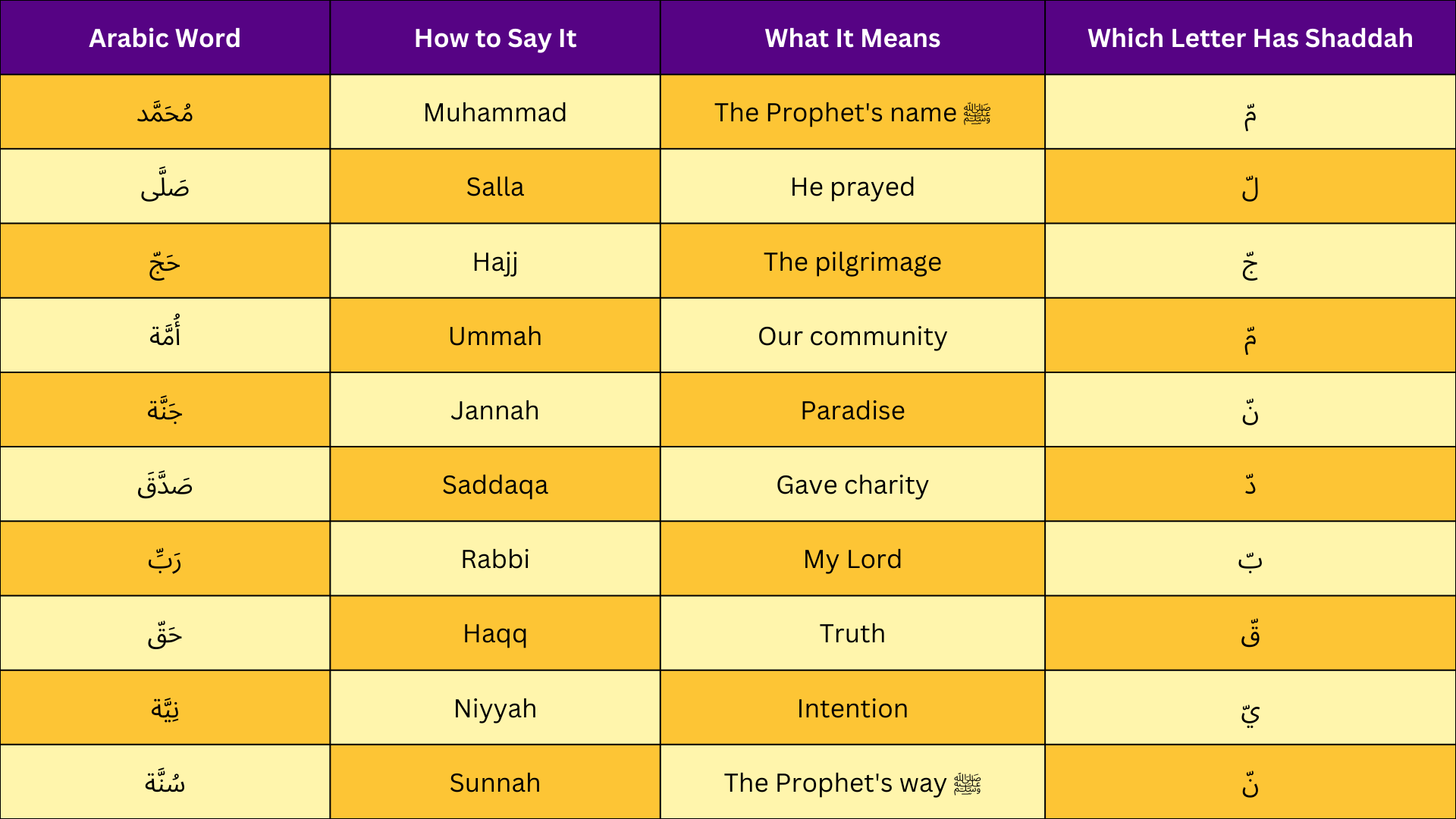
Look, these words are everywhere. Your kids hear them in salah, in conversations, in Friday khutbahs. Once they learn to catch the shaddah in words they're already familiar with, they start noticing it everywhere else too.
Here's what worked for us: I grabbed some index cards and wrote these words out. Then I let my daughter use a bright highlighter to mark just the shaddah letter in each word. Made it neon green. She thought that was way more fun than just reading them off a screen. Then we'd practice saying them, and she'd hunt for the shaddah each time.
Or sometimes when we're just sitting around, and someone mentions "Jannah" or says "Muhammad," I'll ask her, "Hey, where's the shaddah in that word?" She loves showing off that she knows. Turns it into a little moment instead of feeling like homework.
The point is, the more they see shaddah in words they already use, the faster they get it. They're not learning something totally new; they're just learning to see what was already there.
By the way, if your kids are the type who get bored with flashcards after two minutes (mine definitely are), Islamic Galaxy has some really good interactive stuff for learning Arabic and Tajweed. Games, activities, things that actually keep them engaged. Just something to check out if you need backup.
Okay, so now you know what shaddah looks like in common words. Next, let's talk about what happens when shaddah shows up with other marks like fatha, kasra, and damma...
How Shaddah Works with Other Marks (Harakaat)
Ok, this is something that parents get confused with initially, but actually Shaddah is quite simple when you understand it. A Shaddah is not independent by itself. It goes together with one of those small vowel marks (harakaat) to give you the exact sound of the letter that is doubled.
There are three main vowel marks in Arabic: fatha, kasra, and damma. When shaddah combines with any of these, you get different sounds.
Shaddah + Fatha ( َّ )
When shaddah sits together with a fatha (that little dash above the letter), the doubled letter gets an "a" sound.
So if you see مَّ, you say it like "mam-ma." The first "m" is quick and silent, then "ma" comes right after with the "a" sound from the fatha.
Here's a word your kids probably know: جَنَّة (Jannah). See that shaddah with fatha on the نَّ? That's what makes it sound like "Jan-nah" with that nice doubled "n" in the middle. Without the shaddah, it would just be "Jana," which sounds totally different.
Shaddah + Kasra ( ِّ )
When shaddah pairs up with a kasra (the little dash below the letter), the doubled letter gets an "i" or "ee" sound.
So لِّ sounds like "lil-li." That kasra underneath gives it that "i" sound.
Perfect example: رَبِّ (Rabbi). The shaddah is on the بِّ with a kasra below it, so it sounds like "Rab-bi." We say this word all the time in the Qur'an. That kasra is what gives it that "bi" ending instead of "ba" or "bu."
Shaddah + Damma ( ُّ )
When shaddah sits with a damma (that tiny curl shape above the letter), the doubled letter gets an "u" or "oo" sound.
So رُّ would sound like "rur-ru."
Check out الصَّمَدُ (As-Samadu) from Surah Al-Ikhlas. At the end, there's a damma on the last letter. If there was a shaddah with that damma, you'd hear that "u" sound doubled. The damma tells you which vowel sound to use.
Here's how I explain it to kids: think of shaddah as the "doubler" and the harakah (vowel mark) as the "voice." Shaddah's job is to double the letter. The harakah's job is to tell you what sound to make. Put them together, and you get the full, correct pronunciation.
It's kind of like LEGO blocks. Shaddah by itself doesn't do much. Harakah by itself is just a vowel. But snap them together? Now you've got exactly what you need: shaddah + harakah = complete sound.
My son actually got this analogy right away and started calling them "sound LEGOs" for like a month. Whatever works, right?
Shaddah vs. Other Tajweed Marks (Quick Comparison)
It's like when your child takes a Qur'an to read for the very first time and sees these small dots all over the place; it appears to be a mess. Dots, lines, small signs. I can still recall my son staring at me in disbelief and saying, "What is all this?"
Let me break down the main ones so you can actually tell them apart:
| Mark | Looks Like | What It Does | Example |
| Shaddah | ّ | Doubles the letter | مَّ = "mam-ma" |
| Sukoon | ْ | Stops the sound dead | مْ = silent "m" |
| Tanween | ً ٌ ٍ | Adds "n" at the end | كِتَابًا = "kitaban" |
| Fatha | َ | Short "a" sound | مَ = "ma" |
| Kasra | ِ | Short "i" sound | مِ = "mi" |
| Damma | ُ | Short "u" sound | مُ = "mu" |
Look, kids mix these up constantly because they're all small and squished together. Even adults learning Arabic get confused at first. It's totally fine.
The easiest way to remember them? Think about what each one does. Shaddah doubles stuff. Sukoon stops everything. Tanween throws an "n" sound on the end. The other three (fatha, kasra, damma) are just your basic vowel sounds. Once they can pick them out visually, then you move to actually saying them right. But one step at a time.
And here's the thing: your kid doesn't need to memorize all the fancy Arabic names for these marks. Honestly. If they just know "oh that one doubles the letter" or "that one stops the sound," that's good enough for now. The technical terms can come later if they are ever needed.
How to Teach Shaddah to Kids: 5 Practical Tips
Alright, so you understand shaddah now. But how can you really teach that to a six-year-old who is hardly able to sit still for five minutes? I'll just tell you my experience and other parents' experiences that I know.
Tip 1: Start with Listening, Not Reading
Here's the thing: before your kid even looks at a Mus-haf trying to pronounce shaddah, just let them listen for a while. Seriously. Spend a week playing beautiful, slow recitations in the background. Sheikh Mishary Al-Afasy's Tarteel style is perfect for this because it's clear and not rushed.
Don't drill them on rules yet. Just let their ears soak it in. While you're listening together.
Tip 2: Use Color Highlighting
This one's a game changer. Grab a colorful Mus-haf or print out some pages from online, and hand your kid a bright highlighter. Green or orange works great. Then tell them, "Let's go on a shaddah treasure hunt!"
Let them highlight every single shaddah they can find in one surah. Make it fun. Count them together. "Wow, you found seven!" This visual approach helps them see the pattern before they even try to say it. Plus, kids love marking things up.
Once they've highlighted a full surah, go back and read it together, pausing at every single green mark. They'll start connecting that visual cue with the doubled sound. It sticks way better than just explaining it.
Tip 3: Practice One Short Surah at a Time
Don't try to tackle five surahs at once. That's overwhelming. Pick ONE short surah that has lots of shaddah in it. Surah Al-Ikhlas is absolutely perfect for this.
Spend three to five days just on that one surah. Listen to it. Repeat it together. Record yourselves saying it. Listen to the recording. Repeat. Keep going until they've really nailed the shaddah in that surah.
Then, and only then, move to the next one. Depth beats breadth every single time with kids. It's way better for them to master one surah completely than to kind of know ten surahs poorly.
Tip 4: Use Repetition Games
If you try to make this feel like school, your kid will check out in about two minutes. Turn it into a game instead.
Try "Echo Recitation": you say one ayah with clear shaddah, and they echo it back to you three times. Or do "Slow-Motion Recitation," where you both recite super slowly and exaggerate all the shaddah sounds. Kids think this is hilarious.
You can even make up "Shaddah Bingo," where every time they pronounce a shaddah correctly, they get to mark off a square. First one to get five in a row wins.
Tip 5: Record and Compare
Pull out your phone and hit record while your child recites a surah. Then play it back and listen together. After that, play a professional recitation of the same surah.
Compare them side by side. Ask questions like, "Where did you hold the shaddah? Where did the sheikh hold it longer?" The point isn't to criticize. It's just about training their ear to hear the difference.
Look, it really comes down to three things: patience, consistency, and not being too serious. Don’t make your shaddah practice a stressful type of thing where, in the end, no one is happy. I promise that five minutes a day of playful, focused practice is better than one long, tense session on the weekend every single time.
You've got this. Your kid will get it. It just takes a little time and repetition. And honestly? The fact that you're even reading this and trying to help them learn properly means you're already doing great.
Fun Activities for Practicing Shaddah
Alright, let's be real. If you sit your kid down and say, "Time for Tajweed practice," they're probably going to groan and suddenly remember they need to use the bathroom. But if you turn it into a game? Totally different story.
Here are some activities that actually work because kids don't realize they're learning.
"Spot the Shaddah" Game
Grab a Mushaf or print out a page from a surah your child knows. Set a timer for two minutes and see how many shaddah marks they can find and circle.
Make it competitive if you have more than one kid. "Whoever finds the most shadda wins!" My daughter gets so into this that she forgets she's supposed to be learning Arabic.
Shaddah Coloring Pages
This one's simple, but kids love it. Print out some Arabic words or short ayat and give them highlighters or colored pencils. Their job? Color every single letter that has a shaddah on it.
Use bright colors. Green, orange, pink, whatever they like. The more colorful, the better. It turns into an art project instead of a lesson.
Once they've colored all the shaddah letters, go back and practice reading those words out loud together. They'll remember the doubled sound way better because they physically marked it themselves.
Listening Challenge
Play a short clip of Qur'an recitation (again, slow and clear reciters work best). Pause after a word or two and ask, "Did you hear a shaddah in that word?"
If they catch it, they get a point. If they miss it, no big deal, just rewind and listen again together.
This trains their ear without any reading involved. Sometimes kids can hear the shaddah before they can see it or pronounce it themselves. That's totally fine. Ears first, then eyes, then mouth.
The key with all of these is keeping it light and playful. The second it feels like homework, kids tune out. But when it's a game or a challenge or something colorful and hands-on? They're all in.
Looking for more structured games and activities? Islamic Galaxy has a whole section of interactive Tajweed exercises designed specifically for kids. Shaddah challenges, listening games, and pronunciation drills, all built into a platform that actually keeps them engaged. Way easier than trying to come up with new ideas every week. You can check it out and see if it's a good fit for your family.
Alright, now let's wrap this all up with some final thoughts and answers to the questions parents ask me most about shaddah.
Quick Summary: Shaddah in 60 Seconds
Here’s a simple, parent-friendly recap you can skim in under a minute — perfect if you just need the essentials.
Shaddah Essentials:
- What it is: A small mark ( ّ ) that means the letter is doubled.
- How it sounds: You gently hold or press the letter for two quick beats.
- Why it matters: It can change meanings and is essential for correct tajweed.
- Where it shows up: Everywhere — in the Qur’an and in many everyday Arabic words.
- Best way to learn: Listen to slow recitations and practice with familiar, short surahs.
- Common mistakes: Rushing past it or mixing it up with sukoon.
- Teaching tip: Use color-coding, games, repetition, and slow recitation so kids hear the double sound clearly.
Final Thoughts,
Learning shaddah might seem like a tiny detail, but it’s one of those little things that make Qur’an recitation sound clear, beautiful, and full of meaning. Whether you’re helping your 5-year-old with their very first surah or you’re reconnecting with Qur’an study yourself, remind your heart of this: every effort counts, and every correctly pronounced shaddah is an act of worship.
The Prophet Muhammad ﷺ said, “The one who is proficient in the recitation of the Qur’an will be with the noble scribes, and the one who recites with difficulty, striving to recite as best as he can, will receive two rewards.” (Sahih Muslim)
So whether shaddah feels easy or a little challenging, know that Allah sees your effort and loves your dedication. Keep going, and may Allah make the Qur’an a source of ease, blessing, and light for you and your family. Ameen.
FAQ:
Q1: What is shaddah in Arabic?
Shaddah ( ّ ) is a small mark in Arabic that sits on top of a letter. It means you should pronounce that letter twice; once without a vowel, then with the vowel.
Q2: How do you pronounce shaddah correctly?
To pronounce shaddah, hold the letter for about two quick beats (like two heartbeats). Say the letter once silently, then immediately again with the vowel mark. For example, مَّ is pronounced 'mm-ma' (not just 'ma'). The key is keeping it smooth and connected, with no gap between the two sounds. Listening to slow Qur'an recitations is the best way to train your ear!
Q3: What's the difference between shaddah and sukoon?
Shaddah ( ّ ) and sukoon ( ْ ) do opposite things! Shaddah means hold the letter longer (double it), while sukoon means stop the vowel sound completely. For example: مَّ with shaddah sounds like 'mm-ma,' but مْ with sukoon is just a silent m with no vowel after it. They're easy to confuse visually, but their sounds are very different.