

You know that moment when your child races through Al-Fatiha, and you think, "Something sounds off"? That rushed feeling often comes from skipping a simple but beautiful tajweed rule called Madd.
The word means stretching or holding certain sounds a bit longer, nothing complicated. It's what makes the recitation of the Qur'an sound natural and fluid rather than breaking up the words into fragments. Your kid is already familiar with the surahs that contain Madd, such as Al-Fatiha and Al-Ikhlas.
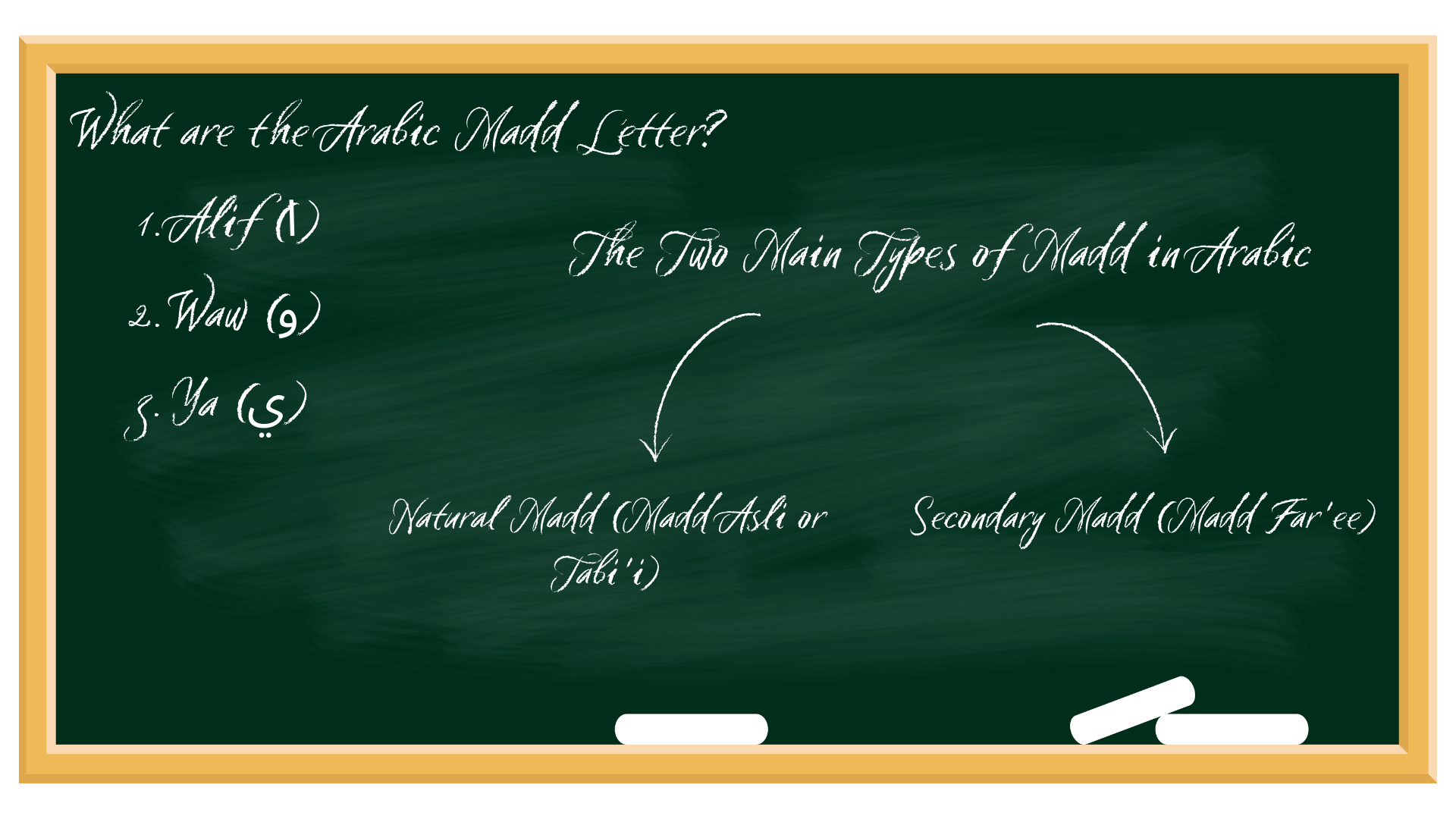
The Madd Arabic letter involves three special letters: Alif (ا), Waw (و), and Ya (ي). By the end of this guide, you'll understand how these work and practice them together using verses your child already loves.
What Are The Arabic Madd Letters?
So, what's Madd anyway? It's just an Arabic word that means stretching. When your child is reading the Qur'an, Madd is about holding certain sounds a little longer instead of rushing through them. Nothing fancy, just letting some sounds linger.
You've probably heard someone recite and thought, "Wow, that sounds so smooth." Much of this understanding comes from figuring out the right time to lengthen these sounds. After that, you won't be able to keep from seeing it all around.
The Three Letters That Do This
Good news, there are only three letters you need to watch for:
- Alif (ا) – Stretches when there's a Fatha (the "ah" sound) before it.
- Like قَالَ (Qā-la) – "he said." That "aa" naturally wants to extend.
- Waw (و) – Creates the stretch when a Damma (the "oo" sound) comes before it.
- Example: يَقُولُ (Ya-qū-lu) – "he says." You hold that "oo" sound.
- Ya (ي) – Stretches after a Kasra (the "ee" sound).
- Like قِيلَ (Qī-la) – "it was said." The "ee" gets held a bit longer.
Why "Long Vowels"?
The reason why these are called "long vowels" is just that they prolong the vowel sounds. An analogy can be drawn with singing when you hold one note instead of jumping quickly to the next one. These three show up very often in the Qur'an, so learning them is certainly advantageous.
Alright, now let's talk about the different types of Madd and when you use each one.
The Two Main Types of Madd in Arabic
Alright, so now that you know which letters create Madd, let's talk about how long you actually hold these sounds. There are two main categories, and honestly, you don't need to overthink this part.
Natural Madd (Madd Asli or Tabi'i)
When children are just beginning, this is the kind of one that you will probably see the most often. The reason why it is referred to as "natural" is that it takes place on its own when you are reading; there is no need for any particular condition. You hold it for 2 counts. Think of it like two gentle beats: "one, two." That's it. The length never changes. It's always the same.
Here's a perfect example from Al-Fatiha: الرَّحْمَٰنِ (Ar-Raḥ-mān) – "The Most Merciful." That long "aa" sound in "Raḥmaan" is Natural Madd. Two counts, every time.
Secondary Madd (Madd Far'ee)
This type gets held longer than 2 counts—usually 4, 5, or even 6 counts, depending on what comes after the Madd letter. It's a bit more advanced and happens under specific conditions we'll break down later.
For now, don't stress about it. When you're teaching your child, you'll mostly work with Natural Madd. That's the foundation. Once they're comfortable with that, the other types become much easier to understand.
Is Arabic learning something you want to make easier for your kids? Get acquainted with the Islamic Galaxy's Arabic learning programs that are specially created for kids.
They simplify tajweed rules like this in enjoyable, very small lesson units that really remain. Let's dive deeper into Natural Madd and see exactly how it works in verses your child already knows.
Natural Madd (Madd Asli) in Detail
What Is Natural Madd?
This is the main Madd, the one that appears very frequently in the Qur’an. It is termed "natural" because it is simply done while you are reading without any interruption. No special conditions or intricate rules are necessary.
The stretch is always 2 counts. No exceptions, no variations. Just a gentle "one, two" every single time. Once your child gets used to it, they'll do it without even thinking about it. It becomes automatic.
How Do You Spot It?
Here's a super simple checklist to find Natural Madd:
- Look for one of the three Madd letters – Alif (ا), Waw (و), or Ya (ي)
- Check what's before it – Make sure the letter before has the matching vowel (Fatha for Alif, Damma for Waw, Kasra for Ya)
- Check what's after it – There shouldn't be a hamza (ء) or sukoon (ْ) right after the Madd letter
- Hold for 2 counts – That's it. Count "1, 2," and you're good.
Examples Your Child Already Knows
Let's use Surahs kids recite all the time:
- From Surah Al-Fatiha:
- مَالِكِ يَوْمِ الدِّينِ (Mā-li-ki yaw-mid-dīn) – "Master of the Day of Judgment."
See that Alif in مَالِكِ? That's Natural, Madd. Try saying "Maa-li-ki" and hold the "Maa" like you're counting "1, 2" in your head.
- From Surah An-Nas:
- مِن شَرِّ الْوَسْوَاسِ الْخَنَّاسِ (Min shar-ril was-wā-sil khan-nās)
Look at النَّاسِ (An-Nās). The Alif after the "n" sound stretches for 2 counts. "Naa-s."
How to Practice This with Your Child
Go slow. Seriously, there's no rush. Read one verse at a time together.
Count out loud: When you hit a Madd letter, whisper "1, 2" while stretching the sound. It helps them feel the rhythm.
Listen together: Put on a recitation by Sheikh Mishary or another reciter your family likes. Pause and say, "Did you hear how he held that sound?" Kids pick up so much just by listening.
Stick to one surah: Don't jump around. Master Al-Fatiha first, then move to another short surah. Now that Natural Madd makes sense, let's look at the times when Madd gets stretched even longer.
Secondary Madd (Madd Far'ee) Simplified
So far, we've talked about the regular 2-count Madd. But sometimes you'll need to hold the sound longer than that, maybe 4, 5, or even 6 counts.
This happens when specific letters come right after the Madd letter. The two big ones to watch for are hamza (ء) and sukoon (ْ). When you see either of these following a Madd letter, the stretch gets extended.
Don't worry, what you just heard sounds more complex than it really is. These are the three types you'll see most
1. Connected Madd (Madd Muttasil)
This one happens when the Madd letter and a hamza are in the same word. When that happens, you hold the sound for 4 or 5 counts instead of just 2.
Example: جَاءَ (Jā'a) – "he came"
See how the Alif and the hamza are both in the same word? Stretch "Jaa" longer—count "1, 2, 3, 4" in your head. It feels different from the quick 2-count you're used to.
2. Separated Madd (Madd Munfasil)
That is the case when a Madd letter is at the end of one word, and the next word begins with a hamza. The length of the extension can be 2, 4, or 5 counts according to the recitation style that you are using.
Example: يَا أَيُّهَا (Yā ayyuhā) – "O you"
You'll see this all over the Qur'an. The "Yaa" at the end of the first word gets stretched because the next word starts with a hamza.
3. Madd Due to Sukoon (Madd 'Arid lis-Sukoon)
This one's a bit different; it only happens when you're stopping at the end of a verse. If there's a Madd letter followed by a letter with sukoon, you can stretch it for 2, 4, or even 6 counts.
Example: الْعَالَمِينَ (Al-'Ālamīn) – "the worlds"
That last "een" sound could be very long if you make a break after this word (for example, at the end of a verse in Al-Fatiha).
Don't Stress About This
Look, these regulations could be intimidating or overwhelming just by being listed like that. However, the truth is that after some practice, following them becomes almost automatic
For now, especially with young kids, just focus on getting Natural Madd down solid. Once that's automatic, these extended ones become way easier to recognize.
And honestly? A good Qur'an teacher will definitely show you the way. There is no need for you to work everything out by yourself.
Quick Reference: Madd Count Lengths
| Type | Counts | When It Happens |
| Natural Madd | 2 | Standard stretch |
| Connected Madd | 4–5 | Hamza in the same word |
| Separated Madd | 2, 4, or 5 | Hamza starts the next word |
| Madd with Sukoon | 2, 4, or 6 | Stopping at the verse end |
Okay, so now we can move on to discussing the ways of practicing all these things with your kid, but not in a way that would seem like a task.
How to Practice Arabic Madd with Your Child
Okay, the theory is just one thing, but how do you actually do this with your kid without either of you losing your patience? This is what a bunch of parents have found to be effective.
1. Stick to Surahs They've Already Got Down
Start with Al-Fatiha or Ikhlas, something your child knows by heart. When they're not scrambling to remember the words, they can actually focus on stretching the sounds right. It's way less stressful that way.
2. Count It Out, Literally
When you get to a Madd letter, just count together. "One, two" for the regular kind. You can tap the table, use your fingers, whatever works. Kids need something physical to latch onto, not just "stretch it longer."
3. Turn It Into a Game, Not a Lesson
Try asking them, "Which part of this word can you say with a long, stretched-out sound?" or "I wonder who can say this sound for the longest time without breathing." In case it still seems like a game, then they would really feel like doing it."
4. Listen to Good Reciters, A Lot
Put on Sheikh Mishary or Hudhaify in the car, during breakfast, whenever. Kids absorb so much just from hearing it done right. Pause sometimes and ask, "Did you catch how he held that sound?"
5. Keep It Short
Ten minutes is plenty. They won't stay focused if the explanation is too long. Spread your work out over the week, little and often, rather than all at once.
6. Highlight the Madd Letters
Grab some colored pencils and mark up a practice copy. Visual kids especially love this; it makes the letters jump out.
7. Record Them
Use your phone. Let them hear themselves. They'll catch things you don't even have to point out.
8. Get a Real Teacher
Look, you can do a lot at home, but nothing beats having someone who actually knows tajweed listen and correct. Joining Islamic Galaxy for Qur'an education with qualified teachers who specialize in teaching kids, they catch the little mistakes that make a big difference down the road.
Basically, it is not your intention to turn your kid into a flawless person in a matter of seconds. It is simply the process of habit formation, one verse at a time
Now, let's go over some questions parents ask all the time about Madd.
Conclusion
So there you have it, Madd Arabic really isn't as complicated as it sounds at first. It's just about stretching certain sounds when you're reciting the Qur'an. You've got three Madd Arabic letters to watch for: Alif, Waw, and Ya. And two main types: Natural Madd (the 2-count kind you'll see everywhere) and Secondary Madd (which stretches longer, around 4 to 6 counts).
The best way to get comfortable with these Madd rules? Practice with surahs your child already knows; Al-Fatiha, Ikhlas, the short ones they've got memorized.
Learning the Quran by Madd is not simply a matter of obeying the regulations; it is more about enabling your kid to recite the words of Allah in a lovely way, the manner in which they should be recited. This, therefore, is an act of worship. Be patient with your child. Be patient with yourself, too. Every small step forward counts.
Why not start today? Sit down together and practice one verse from Al-Fatiha. Notice the Madd in مَالِكِ and stretch that "aa" sound gently for two counts. Do it again tomorrow. And the day after.
With time and a little consistency, it'll become second nature. Subscribe to IslamicGalaxy and let us be part of your journey.
FQA
Q1: How do I know if we're stretching Madd too long or cutting it too short?
Your best bet? Listen to a lot of good recitation in the background, and your ear will start picking it up. The counting is nice as well. After you become familiar with the feeling of "1, 2", you will understand when something is not right. However, to be absolutely honest, if you cannot figure it out at all, have a teacher listen.
Q2: My kid just zooms through Arabic Madd. How do I get them to slow down?
Read together, super slow. Like, painfully slow at first. Go verse by verse and don't move on until they've actually held the sound. Try making it a game, "Okay, let's both do this word and see who can hold it just right." Takes the pressure off, and they actually start paying attention.
Q3: Are the Madd rules different depending on how you recite?
Mostly, they're the same. Most of us follow Hafs 'an 'Asim, that's the standard you'll hear almost everywhere. The counts (2, 4, 6) that we mentioned are derived from that. There are other recitation styles (Qira'ahs) which may elongate the syllables differently, but if you are not going deep into it, then you don't have to concern yourself with it.